|
|||||||||||||||||||||
 |
|||||||||||||||||||||
 |
|||||||||||||||||||||
 |
|||||||||||||||||||||
 |
|||||||||||||||||||||
 |
|||||||||||||||||||||
 |
|||||||||||||||||||||
 |
|||||||||||||||||||||
 |
|||||||||||||||||||||
 |
|||||||||||||||||||||
 |
|||||||||||||||||||||
 |



















|
||||||||||
|
||||||||||
The current issue is always free to everyone If
you need the access available to a |
||||||||||
 |
||||||||||
 |
||||||||||
Recent events affecting the national leadership level of the NAACP brought vividly to my attention the question of the 21st century Black elite role in “outreaching-to-Black-lower-class-crises.” After just under two years as executive officer of the NAACP, Bruce Gordon resigned from that office in December 2006. On March 6, 2007, Bruce Gordon presented a “Memo of Resignation” to members of the NAACP National in which he discussed the core reasons underlying his resignation. A copy of Gordon’s memo was made public through a Black-affairs website named “Afro-Netizen”, in its issue dated March 10, 2007 and later in its issue dated July 16, 2007. I received a copy of Bruce Gordon’s resignation memo in mid-July and after reading it, I had no doubt about its significance to the issue of the role of the 21st century Black elite sector in “outreaching-to-Black-lower-class-crises.” Or to put this matter in the conceptual terms that are implied in Gordon’s resignation memo, his memo relates to the issue of fashioning a new post-Civil Rights Movement leadership identity for the NAACP, an identity that interconnects that great organization’s historical “civil rights advocacy function” with a 21st century “Black social-crisis reformation function.” Bruce Gordon’s resignation memo also has a special significance owing to its intellectual candor, by which I mean the straightforwardness with which Gordon lays out issues surrounding his resignation. It is also significant, therefore, in regard to what the memo reveals about the leadership character of Bruce Gordon. His leadership personality is not given to obfuscation or circumvention, not given to narcissistic pettiness of “one-upmanship behavior” vis-à-vis his professional peers in the institution of which he’s a part, in this case the NAACP — that great warhorse of Black people’s freedom and their struggle against the White supremacist juggernaut in 20th century American civilization. Furthermore, Gordon’s resignation memo is significant in regard to what it reveals about what might be called a “can-do ethos” that informed his decision-making while executive officer of the NAACP for two years. This “can-do ethos” aspect of Bruce Gordon’s leadership style caught my attention during the course of the Katrina Hurricane Crisis in 2005. During the early weeks of watching the television reports on the events of that horrible Katrina crisis unfold — especially as the lives of working-class and poor Black families were being devastated — I remember saying to my wife Marion: “I hope Black national organizations like the church denominations, the Urban League, the NAACP, and professional associations mobilize relief efforts to assist Black families in New Orleans.” Within a week of saying this, we received an e-mail from the NAACP national office notifying people that it had set up an NAACP Katrina Relief Fund, and I returned the NAACP’s appeal message saying that the Kilson family would contribute $2000. Happily, I filed-away a copy of the pledge-letter, dated Sept. 8, 2005, I sent to the NAACP Katrina Relief Fund in which I remarked to the Fund’s director: “It is truly marvelous to have the NAACP under your new executive officer Mr. Bruce Gordon out-front in aiding the thousands of Black citizens, and White citizens too, whose lives have been smashed by the Katrina hurricane.” Deconstructing Bruce Gordon's Resignation Memo In his resignation memo Bruce Gordon discusses two plans stemming from what I call his “can-do leadership ethos”, or what also can be called Gordon’s “outreach-to-Black-crises-ethos.” One plan responded to the horrific Katrina Hurricane crisis and especially to massively incompetent response by President Bush’s Republican administration to the Katrina crisis, a crisis that ravaged the lives of thousands of Black families, and White families too. As Bruce Gordon informs us of his plans in his memo:
Bruce Gordon also mentions in his memo a second plan that stemmed from what I call his “outreach-to-Black-crises” leadership mindset. Namely:
However, Bruce Gordon mentions that neither his plan for a “unified position [by black leadership groups] on post-Katrina government response”, nor his plan for a “Medicare Part D enrollment” ever got off the ground. Why?
With regard to Gordon’s first plan, he informs us that “I was faulted for attempting to ‘set policy’.” This response by elements on the NAACP National Board strikes me as bizarre because what else should an executive officer of the NAACP with first-class managerial skills like Bruce Gordon do but “set policy”? His policies or programs-of-action may prove effective or ineffective, but surely it’s his basic function “to set policy”, or at minimum “to propose policy”. With regard to Bruce Gordon’s second plan (“Medicare Part D enrollment”), Gordon says that he was “told that this was a service initiative and we are an advocacy organization.” Furthermore, some members of the NAACP National Board even sought to influence day-to-day operation in the executive’s office. As Bruce Gordon put it:
Clearly, the former NAACP executive officer experienced what might be called a “condition of systemic disarray” during his two-year tenure. Something equivalent to micromanagement-run-amok generated this “condition of systemic disarray” during Bruce Gordon’s brief reign as executive officer of the NAACP. When reading Bruce Gordon’s resignation memo, I took special interest in how the former NAACP executive officer evaluated his sometimes quite testy policy battles with the NAACP National Board. In this regard, I was quite surprised to encounter in Gordon’s resignation memo evidence of something I would call “high-order gentlemanliness” about the man. Rather than enter a kind of face-off defense of his policy initiatives and thus a face-off critique of the opponents of his policy positions, Bruce Gordon reports in a non-judgmental manner on the policy-fissure between himself and a majority on the NAACP National Board. Here’s how Gordon put it:
After this fair-minded and even-handed reporting of a serious policy fault-line between the NAACP executive officer and presumably the majority on the NAACP National Board, Bruce Gordon’s summary observation in his resignation memo sustained a fair-minded argumentative posture, one that was even self-critical. Here’s how Gordon put it:
The concluding section of Bruce Gordon’s presentation of policy differences between him and the NAACP’s National Board reinforced my view of him as a fair-minded administrator. First, he told the NAACP National Board that his “public statements [following his resignation] have not involved any “finger pointing”. He then made reference to his interview on the PBS Television Tavis Smiley Program, an interview which I saw and considered resplendent with evidence of what I view as Bruce Gordon’s “high-order gentlemanliness.” Here’s how Gordon characterized his Tavis Smiley interview:
The evaluation of Bruce Gordon’s interview with Tavis Smiley by Julian Bond (BC Editorial Board member), chair of the NAACP National Board, was right-on-target. I saw Bruce Gordon’s interview with Tavis Smiley and I can report that his performance and comportment were supremely magnificent. There is another aspect of Bruce Gordon’s fair-minded leadership persona worthy of mention. Namely, nowhere in his resignation memo did Gordon identify the NAACP chairperson, Julian Bond, as part of the National Board members who opposed his policy initiatives. Gordon's Resignation Viewed in NAACP Historical Perspective On the basis of my reading of Bruce Gordon’s resignation memo, it appears that he came to the NAACP executive post with a keen — and I believe correct — understanding that the NAACP’s historic “civil rights advocacy function” did not preclude it from performing what I call a “social-crisis reformation function.” I use the term “correct” in characterizing Gordon’s understanding of the interconnectedness between an NAACP “advocacy-cum-social reformation function” for a very basic reason. Because it was the progressive leadership strand — not the centrist-minded leadership strand — during the activist development phase of the NAACP in the 1930s who exhibited an understanding of an interconnection between an NAACP “rights advocacy-cum-social reformation” leadership paradigm. That progressive leadership strand in the 1930s NAACP revolved around James Weldon Johnson (who retired in 1932 to teach at Fisk University and died in a car accident in 1938) and W.E.B. DuBois, while the centrist leadership strand in the 1930s revolved around Walter White (who succeeded Johnson as executive secretary) and his assistant Roy Wilkins.
An interesting account of the 1930s NAACP progressive/centrist leadership strands can be found in David Lewis’ second volume on DuBois’ biography — W.E.B. DuBois: The Fight for Equality and the American Century ,1919-1963 (New York: Henry Holt Co., 2000). As Professor Lewis informs us, by the middle 1930s when the NAACP’s twenty-odd years of challenging the American White supremacist juggernaut did not have many viable successes to celebrate, W.E.B. DuBois began rethinking the basic ideas that informed the NAACP integration civil rights leadership paradigm. He settled on what might be called a one-step-backward-two-steps-forward political vision for the leading ethnic-bloc organization among Black Americans. Recognizing that White ethnic groups such as Irish-Americans, Italian-Americans, and Jewish-Americans used their ethnic-bloc patterns to generate what might be called intra-Irish or intra-Jewish ethnic agencies for social advancement of their communities — a kind of “ethnic-communitarian advancement”, let’s call it — DuBois, a keen student of American society in general, suggested a somewhat similar vision-and-strategy for Black people.
In late 1933 and early 1934, W.E.B. DuBois put forth this suggestion in a series of articles in The Crisis — the NAACP’s official journal which he founded and edited. He proposed that Black American civil rights leadership might place less emphasis on its integration or desegregation strategy, on the one hand, while on the other hand mobilizing Black ethnic-bloc resources (churches, civic associations, trade unions like A. Philip Randolph’s Brotherhood of Sleeping Car Porters, women’s organizations, etc.) along the lines of intra-Black communitarian social advancement. In an article titled “Segregation” that appeared in The Crisis (January 1934), W.E.B. DuBois expressed a deep pessimism on when viable interracial or integration concord would evolve in what was then a rigidly White-supremacist delineated American civilization. “It is impossible to wait for the millennium of free and normal [integration] intercourse,” DuBois lamented in regard to the tenacity of Negro-phobic White behavior in American life. Accordingly, DuBois suggested that Black Americans’ eventual social advancement would increasingly depend upon “the race-conscious black cooperating together in his own institutions and movements,” the purpose of which would be especially “to organize and conduct enterprises.” W.E.B. DuBois observed — correctly I think — that such an intra-Black communitarian thrust was nothing new. Why? Because, as DuBois put it, “the vast majority of the Negroes in the United States are born in colored homes, educated in separate colored schools, attend separate colored churches, marry colored mates, and find their amusements in colored YMCA’s and YWCA’s.” (This sentence, by the way, sounds familiar to the post-Civil Rights Movement era African-American ear, save the phrase “find their amusements in colored YMCA’s and YWCA’s”, a situation now replaced — sadly — by Hip Hop entertainment). And it should be remarked that W.E.B. DuBois had a cogent understanding of the tenacity of the Negro-phobic ethos, nay virus, in American civilization. Research on the history of racist segregation in housing, for example, reveals this tenacity of Negro-phobic White American behavior. For instance, in the study American Apartheid: Segregation and the Making of the Underclass (Cambridge: Harvard University Press, 1993), Professors Douglas Massey and N.A. Denton uncovered that whereas what they termed the “segregation index” for housing patterns stood at 46% in the city of Philadelphia between 1860 and 1910 (a city in which the young DuBois undertook his first sociological research between 1896 and 1899 resulting in the classic study The Philadelphia Negro (1899) ), by 1940 the “segregation index” increased massively to 88.8%, and forty-odd years later in the 1980s the “segregation index” fluctuated between 77% and 79%. (Massey’s and Denton’s “segregation index” of 0% is equivalent to no segregation, while 100% represents total segregation). Not surprisingly, a rather taut ideological fissure surfaced in the NAACP’s leadership circle following DuBois’ public proposal in 1934 to supplement the organization’s official integration policy with what might be called a two-tier or dualistic Black social advancement program. A program combining the historic “civil rights advocacy” function with a “intra-Black communitarian uplift” function. Not only did W.E.B. DuBois’ critics among the NAACP leadership circle — especially Walter White and Roy Wilkins — vigorously oppose a two-tier policy strategy for the NAACP (what today I characterize as a “civil rights advocacy-cum-social reformation” strategy). They went from policy opposition to maneuvering to have W.E.B. DuBois dismissed from his longstanding editorship of The Crisis (since 1910), an outcome that was officially effectuated as the year 1934 closed down. In W.E.B. DuBois: The Fight for Equality and the American Century, 1919-1963 (1993), Professor David Lewis’ treatment of the policy fissure between DuBois and the NAACP centrist-minded leaders like Walter White and Roy Wilkins in 1934 is, from my perspective, rather problematic. Lewis relates in a favorable tone the Byzantine maneuverings by Walter White and Roy Wilkins that closed the door on W.E.B. DuBois’ intellectually and politically outstanding role in the official ranks of the NAACP as founder-editor of its great journal The Crisis. For David Lewis, DuBois’ embrace of an intra-Black communitarian policy perspective for the NAACP marked the nadir of DuBois’ leadership career.
Lewis, for instance, refers favorably to an insulting commentary on DuBois’ intra-Black communitarian proposal by the conservative Black columnist for The Pittsburgh Courier, George Schuyler, who remarked: “Imagine the Top Sergeant of the Talented Tenth [W.E.B. DuBois] fouling like a punch drunk pugilist despairing of victory.” For David Lewis, George Schuyler’s infantile, tacky, and profane commentary on DuBois’ Black communitarian ideas “was [an] apt judgment.” (p.104) In proposing a two-tier NAACP leadership perspective, W.E.B. DuBois was not indulging in typical one-dimensional separatist “black nationalism nostrums”, as Professor David Lewis claims. Nor was he throwing-in-the-towel on the historic “civil rights advocacy” NAACP role against American racism. Quite the contrary. Rather, DuBois’ Black communitarian ideas were premised on an insightful understanding by DuBois about Black American’s generic socio-cultural attributes in American life. Namely, that Black Americans are both a “racial group” and an “ethic group”. As a “racial group” Black Americans can be thought of as a defensive ethnic group, which is to say as a group shaped in part by oppressive White supremacist dynamics in American civilization. As an “ethnic group” Black Americans can be thought of as an offensive ethnic group, which is to say as a group like Irish-Americans and other White ethnic groups who are fashioned by organic historical-cultural patterns, such as religion, folk beliefs and heritage, cultural-expressive practices, familial authority practices, and linguistic patterns. Accordingly, when W.E.B. DuBois promulgated his two-tier policy perspective (civil rights advocacy-cum-Black communitarianism) in his famous essay titled “Segregation” in The Crisis (January 1934), he introduced what might be dubbed a “new civil rights rhetoric”. This new civil rights rhetoric sought to place the plight of the dark-skinned working-class majority of African-Americans in the pre-World War II era at the center of the mainline civil rights organization’s policy agenda — the NAACP’s agenda. After all, by the 1930s — despite a quarter-century emphasis on integration policies by the NAACP and its allies among liberal White Americans — the plight of the dark-skinned working-class Black masses in cities and in agrarian areas remained one of precarious jobs when they had jobs, poor education opportunities, and poverty-level living conditions. U.S. Census Bureau data for 1940, as World War II commenced for the United States, reported some 90% of African-Americans classified as living at poverty-level. Unique Social Crises Facing Today's Black Lower Class - The Crisis Context Returning our discussion to present-day circumstances, in our early 21st century contemporary era it has become indisputably clear that the multi-layered social crises plaguing the African-American lower-class sector have impacted the affairs of the NAACP in unique ways. In fact, these crises impact the affairs of Black leadership in general. After all, the social crises plaguing lower-class African-Americans are systemically and culturally tenacious crises. Among them are the following:
These post-Civil Rights Movement era social crises that are now ravaging the life-cycle and life-chances of lower-class African-Americans have brought forth a new type and range of claims upon the mainline African-American leadership institutions, and especially on the premier of these leadership institutions — the NAACP. I for one have enormous faith in the leadership resilience and innovativeness of the great warhorse of Black people’s freedom that the NAACP has been and remains today. So I am in full concord with the “can-do leadership ethos” that former NAACP executive official Bruce Gordon demonstrated during his all-too-brief two-year tenure.
Be that as it may, in order to gain a sharper understanding of the current depth-and-range of social crises now plaguing the life-chances of today’s weak-working class and poor African-American families, let me discuss several facets of these social crises that have been cogently portrayed in articles by one of the major columnists writing today in top-rank national newspapers — namely, The New York Times columnist Bob Herbert. Bob Herbert’s Cogent Discourse On Black Social Crises It is clear that from the early 1980s onward, African-American society has experienced a kind of two-tier bifurcation of its social class pattern. Within this bifurcated class pattern entailing a “static-stratum” sector (e.g., weak working-class and poor families) and a “mobile-stratum” sector (e.g., middle-class and professional-class families), what might be termed a “troubled Black America dynamic” can be found. For example, while middle-class and professional-class African-Americans inhabiting the “mobile-stratum” (around 60% of Black Americans) have advanced up the American social mobility ladder, those African-Americans inhabiting the “static-stratum” (weak- working-class and poverty-level ranks) seem to dwell in a “vegetated state-of-social-crises”, so to speak. What the articles by the African-American columnist for The New York Times have uniquely provided over the past decade is a cogent and sharp vista on the “troubled Black America dynamics”. Bob Herbert’s cogent and sharp vista on contemporary Black American social crises can be found especially in his New York Times columns that appeared March 5 and March 15, 2007. These articles (one titled “Education, Education, Education" — March 5 — the other “The Danger Zone” — March 15) discuss the nitty-gritty details of contemporary Black American social crises, especially the Black-youth social crises. The Black-youth social crises probed by Bob Herbert are:
In his
March 5 column “Education, Education, Education”, Bob
Herbert details in graphic ways the education status
of Black males, showing first the education benefits
among Black males associated with education achievement,
and then showing the horrible downside associated with
high dropout rates. Herbert summarizes new research
from a study produced by the Center for Labor Market
Studies at Northeastern University in Boston as follows:
From here Bob Herbert discusses the consequences of poor educational attainment among Black males. Here his tone is dire and foreboding:
Bob Herbert concludes his Education, Education, Education article with what might be viewed as an injunction to middle-class African-Americans to outreach-to-Black-lower-class-crises. Here’s how Herbert put it:
I might add to Herbert’s discussion of today’s education crisis that’s crippling Black youth another set of facts relating to this crisis. These facts are from USA Today (August 6, 2007), reporting that “fourth-graders reading below the basic level” number 59% among African-Americans, compared to 25% among White Americans. Clearly, as Bob Herbert observed, the “effort [to reverse today’s education crisis] can succeed on a large scale only if there is a cultural change in the black community….”
When Bob Herbert takes up the subject of the job-market/job-opportunity crisis facing lower-class African-Americans, he again strikes a quite dire and foreboding analytical tone. He commences his New York Times article “The Danger Zone” (March 15, 2007) thus:
Bob Herbert continues “The Danger Zone” article discussing how little is being done by either the private economy or public policy programs to address the unique and horrendous job-market/job-opportunity crisis of Black males. “However much this epidemic of joblessness may hurt,” observes Herbert, “very little is being done about it.” In regard to the private economy, he notes that “According to the Labor Department, only 97,000 new jobs were created in February [2007]…not even enough to accommodate new entrants to the work force.” And even when there may be a high number of new jobs in a month [e.g., over 300,000 in July 2007] or economic quarter, Herbert observes that, according to studies by the Center for Labor Market Studies at Northeastern University in Boston, “the only groups that have experienced a growth in jobs since the last recession are older workers and immigrants. …Steady jobs with good benefits are going the way of Ozzie & Harriet. Young workers, especially, are hurting, which diminishes the prospects for the American family. And blacks, particularly black males, are in a deep danger zone.”
Bob Herbert concludes his “The Danger Zone” article (The New York Times, March 15) with a critical jab at the indifference of the Republican controlled Congress — through most of the 1990s down to the November 2006 congressional elections — to produce public policies that might help remedy the joblessness crisis facing Black males. As Herbert put it:
Crisis Reformation and Black Elite today: A New Perspective That Black America’s premier leadership agency — the NAACP — is capable of redefining itself for what I view as a new facet of its historic leadership function, I have not the slightest doubt. From my perspective, the main problems confronting this new metamorphosis in the NAACP stem less from “The State of Black America” (to quote the title of National Urban League’s annual volume on African-Americans) than from present-day conditions that define our 21st century oligarchic-capitalist American society.
As the Atlantic Monthly Magazine editor Jack Beatty informs us in Age of Betrayal: The Triumph of Money in America (New York: Alfred Knopf, 2007), today’s oligarchic-capitalist American democracy is a sad country today, a “most distressful nation” (to crib a term used by the University of Chicago sociologist, Andrew Greeley, to characterize societal crises that once plagued Irish-Americans). Which is to say, our country today is a nation wherein top-level business elites claim Gilded Age-type wealth advantage over the typical American citizen, exhibit crude greed-type orientations, and have greed-type economic privileges. Worse still, perhaps, in today’s oligarchic-capitalist America, a corporatist-hegemony is exercised over state and federal legislators, a hegemony that crudely and massively manipulates and influences public policy decisions and outcomes that affect multi-layered spheres in daily American life. Under this kind of oligarchic-capitalist American democracy, it is a Sisyphean undertaking to remedy social crises such as those facing the poor sector in African-American life. Or for that matter any other gigantic American crises, like America’s health care crisis, weakening middle-class crisis, wealth gap crisis, decaying physical infrastructure crisis (e.g., collapsed inter-state highway bridge in Minnesota in August 2007), etc. Interconnecting Civil Rights Advocacy & Social Reformation I came away from reading Bruce Gordon’s resignation memo with two main thoughts. One thought was that both the national NAACP leadership ranks (e.g., the executive officer, chair of National Board, and National Board members) and local NAACP Branches should consider fashioning more operational-connections with the working-class and poor sector in African-American life, perhaps 40% of African-Americans. In doing so, I believe the NAACP can in fact kill-two-birds-with-one-stone, so to speak. By this I mean, the NAACP can not only continue to advance the longstanding historic “civil rights activism/advocacy function”, but also help advance a much needed national-level “Black social-crisis reformation leadership function”. These two functions of Black ethnic-bloc leadership are more interconnected than many members of today’s African-American professional stratum have recognized. I believe that former NAACP executive officer Bruce Gordon uniquely recognized the importance of interconnecting the “civil rights advocacy function” and the “social-crisis reformation function.” He understood that the NAACP national organization could eventually intertwine these two leadership tasks in its operation. The successor to Bruce Gordon’s office — whoever he or she might be — must, I believe, fashion a leadership methodology to institutionalize the interconnection of the combined “civil rights advocacy” and “social-crisis reformation” functions at the top-level of the NAACP, and thereby down through the ranks of its numerous branch offices. There is today plenty of anecdotal evidence suggesting the existence of a broad-based desire among African-Americans for this to happen. Such as a letter published in the July 17, 2007 issue of USA Today (America’s largest circulation newspaper) from a middle-class African-American named Pamela Hairston of Washington, D.C. Ms Hairston wrote:
I have already drawn attention to the important role that Bob Herbert of The New York Times has played in informing the country on the social crises now ravaging the life-chances of weak working-class and poor African-American children and youth. In his article in The New York Times (July 14, 2007), Bob Herbert, without being too explicit about it, is addressing our national-level Black leadership regarding the epidemic of fratricidal violence plaguing Black youth in Chicago this summer of 2007:
Herbert continues this candid account of an epidemic of violent deaths among inner-city school children in Chicago by noting “the tremendous amount of passivity and lack of public outrage.” This lack of outrage is found among the African-American community both in Chicago and elsewhere, a situation Herbert’s article alludes to but doesn’t explicitly mention. Be that as it may, clearly Chicago’s epidemic of violent deaths among school children along with the national-level crises plaguing lower-class African-American life are situations that today’s Black elite sector is, I believe, obligated to address in a substantive manner. Also clearly, the primary ethnic-bloc leadership organization representing African-Americans — the NAACP — is also obligated to address the multi-layered crises facing African-American life. Today's Black Elite Sector Has New Capabilities In light of the multi-layered crises facing African-American families, children, and youth, we must confront candidly the issue of the obligation-and-responsibility of today’s middle-class and professional sector — the Black elite sector — to assist in fashioning solutions to these crises. There is available among today’s Black elite sector a much greater capacity to outreach-to-Black-lower-class-crises than has ever been available to previous generations of African-Americans who fell into the Black elite sector.
We can deduce the existence of today’s new Black elite capabilities from data on the upper-stratum occupational growth among African-Americans during the post-Civil Rights Movement era. A survey of U.S. occupations by the Department of Commerce in 2000 reported that within the ranks of white-collar jobs, African-Americans were increasingly penetrating the upper-tier of white-collar jobs. In the Department of Commerce report, the upper-tier of white-collar jobs were defined as “management, professional, and related occupations.” Accordingly, by 2000 some 25% of employed African-Americans held upper-tier white-collar jobs, which amounted to nearly 4 million African-American individuals. This compared with 18% of Latino-Americans employed in “management, professional, and related occupations.” (See U.S. Census Bureau, Occupations—2000 (Washington, D.C.: Department of Commerce, August 2003) p.6) Furthermore, the categories of African-Americans throughout white-collar jobs were reported in a U.S. Census Bureau survey in 2002 as follows - out of 14,725,000 employed Black Americans:
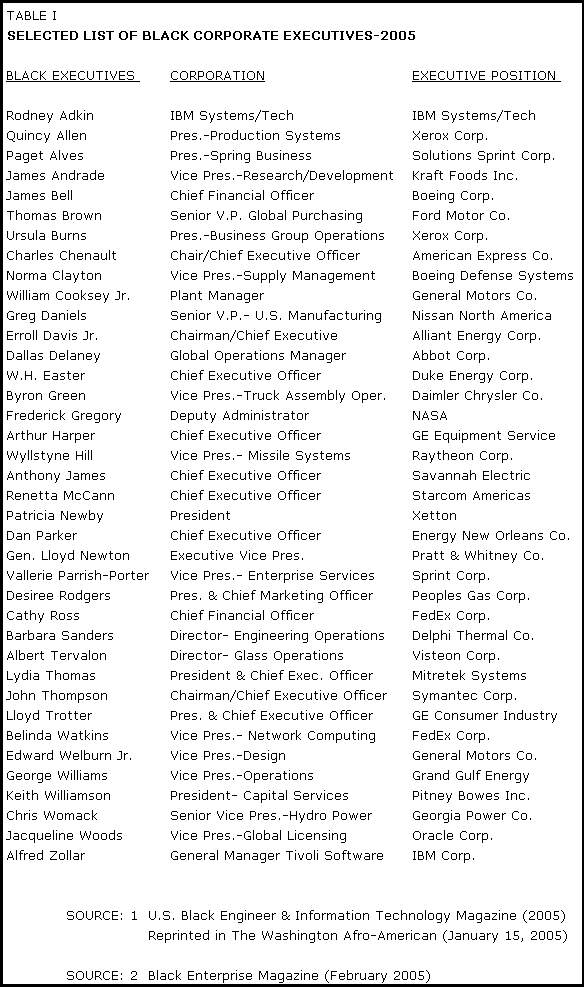
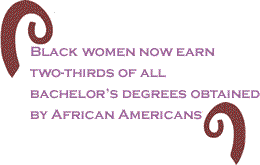
It should also be mentioned that Black females now outdistance Black males in holding upper-tier white-collar jobs. For example, a U.S. Census Bureau survey in 2002 reported that out of 7,931,000 employed Black females in 2002, some 11% (869,000) held “executive, administrator, managerial jobs”. Furthermore, some 15.2% of employed Black females (1,105,000) held “professional jobs”. By comparison with Black males, out of 6,794,000 employed Black males in 2002, some 8.7% (594,000) held “executive, administrator, managerial jobs”, while some 9% of employed Black males (648,000) held “professional jobs”. It is also notable that a recent issue of the Journal of Blacks in Higher Education (Winter 2006-2007) reported that Black women earned 84,965 bachelor’s degrees [in 2005], almost double the 42,879 bachelor’s degrees earned by black men. Black women now earn two-thirds of all bachelor’s degrees obtained by African Americans. (Emphasis Added) This post-Civil Rights Movement era development in regard to the gender patterning of elite-level occupations is, I suggest, of tectonic socio-political significance within African-American life. Among the possible outcomes of this new female-tilted gender patterning of elite-level occupations might be an expansion of liberal and even progressive leadership discourse and action in African-American society. And this possible development might, in turn, translate into an expansion of liberal African-American impacts upon American society in general. Finally, the data shown in TABLE I (List of Black Executives In Major Companies) provide the names of African-American professionals who hold top decision-making positions in major companies. First, the broad range of top companies in which the post-Civil Rights Movement era African-American elite has gained top positions is notable. From Duke Energy Corp. in North Carolina to Raytheon Corp. in Massachusetts; from the Symantec Corp. in California to General Motors Co. in Michigan; so forth and so on. Second, it is noteworthy that, when compared with the representation of White females in executive posts, African-American women are fairly well represented in the list of Black executives in TABLE I. |
||||||||||
 |
||||||||||
Black America’s Two-Tier Class System: A Crisis Fault-Line What the foregoing discussion of the new social class capabilities available to the middle-class and professional sector of African-Americans reveals is that today’s Black America is defined by a two-tier class system. This two-tier class system comprises two main class categories. The lower-tier can be called a “static-stratum", made up of weak working-class and poverty-level African-Americans. Persons in the “static-stratum” hold a variety of weak working-class jobs in factories (janitors, cleaning machinery, unskilled laboring tasks, etc.). They also hold a variety of unskilled jobs in the service economy — e.g., jobs in food-service business, jobs in cleaning service in hospitals, cleaning in public institutions, and domestic service jobs.
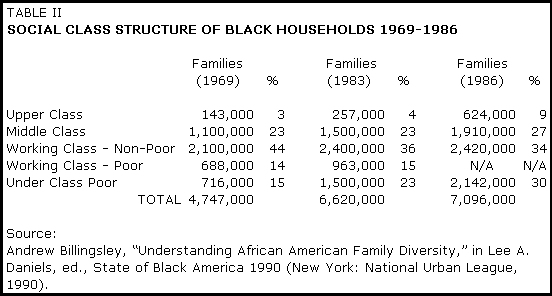
I categorize the upper-tier in Black America’s two-tier class system as a “mobile-stratum”, made up of middle-class, professional class, and capitalist class African-American persons and households. The Black middle-class sector includes stable blue-collar workers, teachers, clergy, barbers, hairdressers, artisans, storekeepers, sales clerks, etc. The professional ranks in the “mobile-stratum” include lawyers, doctors, dentists, nurses, health administrators, college professors, engineers, scientists, technologists, accountants, state/federal administrators, public officeholders, artists, journalists, media professionals, etc. The ranks of African-Americans in capitalist occupations include a broad range of business persons whose occupations are regularly listed in monthly issues of the major African-American business journal Black Enterprise Magazine. These occupations include the following: construction contractors, automobile dealerships, manufacturers, hotel owners, restaurant franchisers, advertising firms, architectural firms, financial managers, bankers, etc. A selected list of capitalist occupations held by African-Americans is shown in TABLE I. Today the upper-tier or “mobile-stratum” constitutes, in aggregate, about 60% of African-American households. On the other hand, the lower-tier or “static-stratum” constitutes, in aggregate, about 40% of African-American households. This “mobile-stratum”/”static-stratum” classification of today’s early 21st century African-American class system corresponds to an analysis by Morgan State University sociologist Andrew Billingsley which was done for the National Urban League’s 1990 annual volume titled State of Black America 1990. TABLE II presents Professor Billingsley’s data. His top-three class categories — upper class (9%), middle class (27%), working-class non-poor (34%) — approximate what I call today’s “mobile-stratum” among African-American households. His bottom-two categories – a combination of working-class poor and underclass (28%) — approximate what I call today’s “static-stratum” among African-American households. Accordingly, following Professor Billingsley’s class categories used in his 1990 National Urban League study, in overall terms I classify 40% of African-American households as belonging to the “static-stratum” and 60% belonging to the “mobile-stratum”. We can gain a sharper view of the “static-stratum” by looking at data from a U.S. Census Bureau survey of American occupations in 2002. That survey reported that low-paying jobs at the bottom of the American occupation ladder (with the exception of “farming, forestry, fishing”) accounted for 4,163,000 Black workers or 28.2% of all employed African-Americans. Returning to Professor Billingsley’s study for the National Urban League’s State of Black America 1990, he provides data on a major crisis-area facing Black Americans in the “static-stratum” — namely, fragile families. Billingsley records that “working-class poor” Black households had a 67% single-parent rate, and that “underclass” Black households had a 75% single-parent rate. This fragile family pattern means, moreover, that over 60% of African-American children are being raised in economically distressed family dynamics. An overall view of these economically distressed family dynamics is provided by national-level poverty data, which show that as of 2005 the poverty rate for African-Americans was 25% (down from 32% in the 1980s), as compared to a 29% poverty rate for Latino-Americans. |
||||||||||
 |
||||||||||
The emergence of a two-tier class system in African-American society during the post-Civil Rights Movement era has resulted in what I’ve already referred to earlier as a “troubled Black America.” This is a Black America many of whose citizens now witness their life-chances being strangled by an array of social crises. While the American national economy and the federal government have the major moral responsibility for assisting in remedying African-Americans’ social crises, there is an important contribution to remedying these social crises that today’s Black elite sector can also make. I want to conclude this article with a discussion of what that contribution might be. Three Suggestions for Black Elite Outreach to Black Crises As my discussion above of the new social-class capabilities of the post-Civil Rights Movement era African-American elite sector makes clear, that sector now has more resources at its disposal for executing an outreach-to-Black-crises-leadership demeanor than any previous elite sector in modern African-American history. What is now needed is “an expansion of Black-elite will”. A flowering of “Black-elite will” toward remedying social crises among lower-class African-Americans.
One crucial element underlying the issue of “Black-elite will” relates to African-American familial patterns. Namely, the fact that a sizable segment of African-Americans now located in the ranks of the Black elite were the first of their family line to reach middle-class and professional status, so they have family members or relatives who are bordering on or in the weak working-class and poor sector. In a certain sense, then, there is a kind of generic moral obligation for some Black elite persons to come to grips with addressing Black lower-class crises. The African-American philosophy scholar at Princeton University, Professor Cornel West, touched on the familial issue associated with the question of “Black-elite will” during an interview with the editors of Black Enterprise Magazine ( February 2005). When asked what he thought about the overall education advancement available to African-Americans, Professor West remarked: “I think it’s magnificent for [the] black middle class and above, but it’s a national disgrace for the black working poor and the very poor. There is a class difference that we have to acknowledge. Sure, for my son and my daughter, it’s cool….I have some cash. You know what I mean? But I have cousins and I have friends and relatives who are not as blessed as I am.” I suggest that there are three basic programmatic-areas of Black–elite-outreach-to-Black-crises that should gain the attention of today’s Black middle-class and professional sector. The three programmatic-areas that I suggest for a Black-elite uplift interface with lower-class Black crises are the following:
A Black Educational Renewal Movement A Black Educational Renewal Movement can address the twin-problems of deficient educational opportunities (e.g., under-funded urban schools, low quality teachers in many inner-city schools, etc.) and deficient educational outcomes (e.g., high dropout rates, low student achievement, etc.). These interrelated problems are legion. As I noted above, quoting figures from the so-called “nation’s report card” — the National Assessment of Educational Progress issued by the U.S. Department of Education — as reported in USA Today (August 6, 2007), some 59% of Black fourth-graders read below the basic level, as compared with 25% of White fourth-graders. Black teachers and their associations, Black academics and college administrators can take the lead role in launching a Black Educational Renewal Movement. And contributions to such a movement by White teachers and academics will be welcome. A similar welcome extends to teachers and academics among Asian-Americans and Latino-Americans. After all, Black Americans’ struggles and movements to secure modern citizenship freedom and advance modern social mobility have been overwhelmingly pluralistic in purpose and functioning. This racial-inclusive pluralism principle extends back to the heroic anti-slavery Abolitionist Movement and reaches forward through the twentieth-century Civil Rights Movement.
Among a concrete and broad-reaching enterprise initiated by a 21st century Black Educational Movement might be, I suggest, a revival of the Black youth education role performed by African-American church congregations some four generations ago, during the 1930s. Data on the education role of Black churches and their national denominations (e.g., African Methodist Episcopal, African Methodist Episcopal Zion, Colored Methodist Episcopal, and National Negro Baptist) can be found in the annual volume on Black American life produced at Tuskegee Institute during the 1930s, edited by Professor Monroe Work. The Negro Year Book 1931-1932 reported data on 154 church-based schools and academies for African-American children that had been established by 1930, of which 53 were funded by Black congregations affiliated with White church denominations (Presbyterian, Congregationalist, Catholic) while 101 schools were funded by mainline Black church denominations. These 154 church-based Black schools enrolled some 32,777 Black children — 18,349 elementary, 10,876 secondary, and 3,552 “other students.” These church-based Black schools enrolled 1,449 teachers and they mobilized $1,500,000 annual revenue to support their work. From today’s vantage point, that nearly 40,000 Black children and youth were being educated over 75 years ago through schools sustained by African-American religious congregations is a fact of enormous significance. I was particularly interested in the 10,876 figure for secondary school Black youth, because a recent article on New York City’s vocational high schools — officially Career Technical Education (CTE) — by the African-American educator and community activist David R. Jones reported that out of 110,000 students in the city’s secondary vocational programs, some 43% are African-Americans and 44% are Latino. (See The Amsterdam News, August 23-29, 2007). Clearly, our 21st century African-American church denominations have much greater financial resources than African-American churches possessed three quarters of a century ago, which means that a Black-elite initiated Black Educational Renewal Movement today could assist significantly in galvanizing Black churches to revive the great education activities that their predecessors innovated in the 1920s and 1930s. On the high school level in major cities today, a 21st century role in CTE-type schooling by a new African-American church-based education regime could have a significant impact on the life-chances of working-class African-American youth. As David R. Jones observes in his Amsterdam News article titled “Vocational High Schools Need Our Support”:
Clearly, a 21st century new-era contribution by African-American church-based school programs could be stimulated and assisted by a Black Educational Renewal Movement. And if this new-era Black church-based education program focused on something like New York city’s CTE curriculums, a significant advancement of the life-chances of working-class high-school youth would result. Keep in mind that just as most White working-class high-school youth do not attend college and directly enter the job market, neither do most Black working-class youth attend college. It is important, therefore, that our Black working-class youth be prepared while at high school with knowledge and skills that connect them to employment opportunities in solid job-markets like automotive repairs, electronic repairs, fashion industry, graphic arts, computers, etc. Indeed, presently far too many Black youth of working-class and poor backgrounds are high-school dropouts and/or graduate without viable job-market skills. A new-era 21st century contribution by African-American church-based schools - assisted by a Black Educational Renewal Movement - could, I have not the slightest doubt, help to remedy this situation appreciably. A Black Civil Society Revitalization Movement The Black Civil Society Revitalization Movement will address a variety of problems associated with the social crises of poverty and joblessness. Problems such as fragile families, teenage pregnancies and unwed motherhood/fatherhood, macho-violence and the related Hip-Hop influenced macho-male “gansta-culture”, massive Black youth homicides spawned by macho-male violence patterns, drug abuse, high HIV/AIDS cases (today disproportionately highest among Blacks in general and Black women in particular), so forth and so on. A viable Black Civil Society Revitalization Movement will also focus on Black neighborhood renewal and development. Especially as this relates to rehabilitating decrepit physical infrastructure (housing, basic commerce relating to food business, barber and hairdressing shops, restaurants, etc.) in so many urban Black neighborhoods. The new class of Black entrepreneurs, financial experts, bankers, media entrepreneurs (e.g., Oprah Winfrey, Tom Joyner, Tavis Smiley, Reginald Hudlin), clothing entrepreneurs (e.g., Russell Simmons), millionaire sports figures (e.g., Michael Jordan, Magic Johnson), millionaire entertainment figures (e.g., Bill Crosby, Harry Belafonte, Danny Glover, Chris Rock), could take leading roles in launching the Black Civil Society Revitalization Movement.
Another sector among the Black elite should also be identified as potential contributors to the leadership roles needed to mount a viable Black Civil Society Revitalization Movement. The sector I have in mind involves the numerous African-American professional associations that have evolved in the post-Civil Rights Movement era. Associations like the following:
Furthermore, owing to the Democratic Party’s fortuitous victory in the 2006 congressional elections, the political class sector of African-American leadership underwent a ground-breaking metamorphosis. Historic legislative power became available to the 42 African-American U.S. Congress legislators. Above all, 4 African-American U.S. legislators for the first-time ever gained the chairmanship of 4 House of Representative Committees and 16 House Sub-Committees. The long-tenured Black congresspersons are now at the helm of politically powerful House Committees. For example:
In short,
when these new advancements in the political attributes of
the aggregate
|
||||||||||
An Anti-Racist Criminal Justice Movement The Anti-Racist Criminal Justice Movement should, I believe, have the status of a political imperative on the African-American leadership agenda. An Anti-Racist Criminal Justice Movement will address the massive and cynical expansion of incarcerated Black males since the late 1970s. Between the 1970s and 2003, the state and federal prison population in America increased from 200,000 to 1,500,000. Today that population numbers over 2,000,000, giving the United States the dubious honor of possessing the largest incarcerated population in the world! Above all, the bulk of the increase in America’s incarcerated population comprises working-class and poor Black males, along with working-class and poor Latino-American males. The political philosophy scholar, Daniel Lazare, has advanced our understanding of the expansion of incarceration in the post-Civil Rights Movement era and how that expansion has devastated the life-chances of working-class African-American males. As Lazare informs us in an article titled “Stars and Bars”, The Nation (August 27/September 3, 2007):
Daniel Lazare’s article also provides special insight into the wreckage visited upon the lives of working-class African-American males, noting that “By the mid-1990s, 7 percent of black males were behind bars, while the rate of imprisonment for black males between the ages of 27 and 29 now stands at one in eight.” Furthermore, Lazare observes that “surprisingly few denizens of the American gulag have been sent away for violent crimes. In 2002 just 19 percent of the felony sentences handed down at the state level were for violent offenses, and of those only about 5 percent were for murder. Nonviolent drug offenses involving trafficking or possession (the modern equivalent of rum-running or getting caught with a bottle of bathtub gin) accounted for 31 percent of the total, while purely economic crimes such as burglary and fraud made up an additional 32 percent.”
Today in major industrial states like New York, New Jersey, Pennsylvania, Ohio, Illinois, Michigan, etc., Black males comprise on average between 50% and 80% of inmates in either state or federal prisons. Data amassed by Professor Manning Marable (BC Editorial Board member) of Columbia University show that by 2000 nearly 50% of inmates in federal prisons were African-Americans. Marable’s research also found that the vast majority of Black inmates committed non-violent offenses, most of which were drug-related. The racist dimension of these criminal justice system outcomes for Black males becomes apparent when it is recognized that national data on illegal drug use show White Americans typically using illegal drugs at higher rates than Black Americans. As Professor Marable has observed:
Professor Douglas Massey, a sociologist at Princeton University’s Woodrow Wilson Center, probes this racist development in the country’s criminal justice system in his very important book Categorically Unequal: The American Stratification System (New York: Russell Sage Foundation, 2006), a book that warrants a wide readership. Massey’s study reinforces the indings made by Professor Marable — that today’s incarcerated Black males committed mainly drug-related non-violent offenses. Moreover, Massey reveals that the 1980s redesign of America’s criminal justice system in the direction of what Massey dubs the “new war on crime” (the “war on drugs”) was engineered and generated mainly by Republican controlled state legislatures and reinforced by Republican federal administrations, always of course with assistance from conservative Democratic state legislators and Congresspersons. As Massey observed in his important book Categorically Unequal: The American Stratification System:
On the basis of Professor Massey’s and other scholars’ study of the racist dimensions of today’s American criminal justice system, there is a pressing need for today’s Black elite sector to mount an Anti-Racist Criminal Justice Movement. The impact of the criminal justice practices on societal decay in the daily lives and future life-chances of millions of African-American weak working-class and poor citizens is massive. Accordingly, an Anti-Racist Criminal Justice Movement would represent a crucial first-step toward reversing the role of high incarceration rates in the social crises among African-Americans . Another reference to Daniel Lazare’s analysis in The Nation of the political consequences of today’s incarceration dynamics tells us how necessary an Anti-Racist Criminal Justice Movement is. Drawing on materials in a new study by Jeff Manza and Christopher Uggen titled Locked Out: Felon Disenfranchisement and American Democracy (New York: Oxford University Press, 2007), Lazare observes:
Daniel Lazare concludes his discussion of the systemic aspects of America’s monstrous incarceration rates with observations on the prominence of what might be called “moralist deology” at the foundation of today’s criminal justice practices. As Lazare put it:
Conclusion: Obligation to the Civil Rights Movement Let me summarize my thoughts on how today’s Black elite sector can mobilize a post-Civil Rights Movement era outreach-to-Black-lower-class-crises. First, this can be achieved through initiatives from the ranks of Black professional associations, from middle-class Black civic and voluntary associations, from the ranks of Black clergy and their churches, through the resources available to the new-rich elements in today’s Black elite — wealthy business persons, corporate executives, entertainment personalities, some sports personalities, etc. Accordingly, insofar as new class and new wealth capabilities are available to the new Black elite sector, the next crucial ingredient required for this sector to fashion efforts at remedying Black lower-class crises is what I call a “flowering of Black-elite will”, that modern leadership quality of “elite obligation to popular society.”
Of course, the Black leadership institutions must shoulder the task of galvanizing into action the new middle-class and professional elements at the top of Black America’s social mobility ladder. Primary among these Black leadership institutions that I have in mind are civil rights organizations, Black advocacy organizations, and Black political class organizations. By name, these include the Southern Christian Leadership Conference, the Rainbow Coalition, the National Urban League, the National Council of Negro Women, the Children Defense Fund, the Council of Black Trade Unionists, the National Caucus of Black State Legislators, and the Congressional Black Caucus. I leave the NAACP as the last-mentioned Black leadership institution because, in my understanding of modern African-American leadership development, the NAACP possesses a kind of “crown jewel” historical leadership status among such institutions. Accordingly, in light of this perspective on the NAACP’s great historical role as African-American’s premier Black leadership agency during the 20th century, there should be today an important rise in NAACP membership among middle-class and professional African-Americans. Among the literally millions of African-Americans employed in white-collar job ranks — nearly 10 million such Black persons are so employed today. Thus, current membership figures between 400,000 and 500,000 for the NAACP are unacceptable, at least from my perspective. Those figures should be somewhere over one million! Moreover, the “Life Membership" category ought to be sizable; it costs one thousand dollars and can be paid in installments. Anyway, “Annual Membership” category in the NAACP is under $50 and no one can tell me that a million-plus individuals in the middle-class and professional stratum of African-American life cannot afford such a membership. Such membership by middle-class and professional African-American (and stable working-class African-Americans too) is owed the NAACP. The defense for this statement is the NAACP’s historical legacy as the great warhorse of Black people’s freedom - the NAACP’s historical legacy of persistent and courageous struggle against the White supremacist juggernaut in American civilization. Furthermore, reports during the spring of 2007 of the NAACP’s financial difficulties — resulting in plans to cut its staff by a third — disturbed me a lot. After all, the Black elite sector today comprises many wealthy individuals — persons with multi-millions at their touch and perhaps a few with billions. Upon reading about the NAACP’s financial troubles, I thought to myself: “Aren’t there a few among that special category of today’s Black elite sector who will make available to the NAACP financial contributions (gifts, loans, or whatever) to ease that historic Black American institution’s financial troubles? There must be. I refuse to believe otherwise."
One final observation. Although over the past decade or so the NAACP has mounted social-crisis remedying programs relating to the problems of education performance among African-American children and youth, there is a much larger programmatic-platform in the overall sphere of Black social crises for the 21st century NAACP to mount. It can be said, I think, that it is to the leadership credit of the former executive officer of the NAACP — Bruce Gordon — that he clearly understood the imperative need for today’s Black elite sector to design and execute social-crisis reformation programs to remedy the plight of weak working-class and poor African-Americans. It is to the leadership credit of Bruce Gordon that he initiated, in the leadership circle of the NAACP, the topic of fashioning a new leadership profile that interconnects its historic “civil rights advocacy function” and “social-crisis reformation function”. I trust that a full-fledged adoption of such a new leadership profile at the national level of the NAACP is not too far in the future. BlackCommentator.com Editorial Board member Martin Kilson, PhD hails from an African Methodist backgound and clergy: From a great-great grandfather who founded an African Methodist Episcopal church in Maryland in the 1840s; from a great-grandfather AME clergyman; from a Civil War veteran great-grandfather who founded an African Union Methodist Protestant church in Pennsylvania in 1885; and from an African Methodist clergyman father who pastored in an Eastern Pennsylvania milltown--Ambler, PA. He attended Lincoln University (PA), 1949-1953, and Harvard graduate school. Appointed in 1962 as the first African American to teach in Harvard College and in 1969 he was the first African American tenured at Harvard. He retired in 2003 as Frank G. Thomson Professor of Government, Emeritus. His publications include: Political Change in a West African State (Harvard University Press, 1966); Key Issues in the Afro-American Experience (Harcourt Brace Jovanovich, 1970); New States in the Modern World (Harvard University Press, 1975); The African Diaspora: Interpretive Essays (Harvard University Press, 1976); The Making of Black Intellectuals: Studies on the African American Intelligentsia (Forthcoming. University of MIssouri Press); and The Transformation of the African American Intelligentsia, 1900-2008 (Forthcoming). Click here to contact Dr. Kilson. |
||||||||||
|
||||||||||
|
||||||||||
 |
||||||||||
 |
||||||||||

Your comments are always welcome.
e-Mail re-print notice
If you send us an e-Mail message we may publish all or part of it, unless you tell us it is not for publication. You may also request that we withhold your name. Thank you very much for your readership. |



















| September
27, 2007 Issue 246 |
||||||||||||||
|
||||||||||||||
| Printer Friendly Version in resizeable plain text format format | ||||||||||||||
 |
||||||||||||||
|
||||||||||||||
 |
||||||||||||||
 |
||||||||||||||
| |
||||||||||||||
 |
||||||||||||||
 |
||||||||||||||
 |
||||||||||||||
 |
||||||||||||||
 |
||||||||||||||
 |
||||||||||||||
 |
||||||||||||||
|
||||||||||||||
|
||||||||||||||
|
||||||||||||||
|
||||||||||||||
| |
||||||||||||||
| |
||||||||||||||