Dick Cheney, who died this week
at age 84, was one of the most powerful
and controversial figures in modern American
politics. The former Vice President leaves
behind a complicated legacy - marked by the
Iraq War, expanded executive power, and
decades of polarizing policy. Yet in his
twilight years, Cheney performed an act of
rare political courage: he stood against
Donald Trump and, in a move that shocked
Washington, endorsed Kamala Harris for
president. That single act - rooted in
principle rather than politics - may well be
remembered as his finest hour.
Cheney’s
endorsement of Harris was not a conversion to
liberalism. It was a declaration of loyalty to
democracy itself. He did not suddenly embrace
the Democratic platform; rather, he rejected
the authoritarian drift that has consumed the
Republican Party he once helped lead. Cheney
understood, perhaps more clearly than most,
how fragile our democratic institutions can be
when power is placed above principle. When he
endorsed Harris, he wasn’t crossing the aisle
- he was drawing a line in the sand.
In
his lifetime, Cheney was known for his stern
demeanor and hard-right convictions. He was
the architect of the Bush-era doctrine that
justified preemptive war. Progressives saw him
as the embodiment of imperial overreach. But
in his later years, Cheney found himself cast
out by the very movement he once helped
define. His insistence that truth and
constitutional order mattered more than
personal loyalty put him squarely at odds with
Trumpism. When his daughter, Liz Cheney,
joined the January 6th Committee to hold Trump
accountable, she became a political exile in
her own party - defeated in Wyoming by a
Trump-endorsed challenger. Dick Cheney’s
support for her stance, and his unflinching
criticism of Trump, made clear that the
Cheneys’ conservatism was grounded in respect
for the rule of law, not blind allegiance to a
man.
Trump’s
response to Cheney’s integrity was predictable
and petty. When Cheney and his daughter
endorsed Kamala Harris in 2024, Trump took to
his social-media platform to call them
“irrelevant RINOs” - Republicans in Name Only
- and mocked Cheney’s long career in
government. He conveniently ignored that he
himself had once praised Cheney for his
toughness, even pardoning Cheney’s former aide
Scooter Libby in 2018. That reversal - from
admiration to ridicule - captures the moral
collapse of Trump’s Republican Party. In
Trump’s world, loyalty matters more than
leadership, and dissent is treated as
betrayal.
Even
in death, the divide remains sharp. As of this
writing, Trump has not issued a statement
mourning Cheney’s passing. His silence speaks
volumes. Every living president - Democrat and
Republican alike - has acknowledged Cheney’s
immense, if complicated, role in shaping
American foreign and domestic policy. But
Trump, consumed by grievance and incapable of
grace, could not bring himself to offer even a
perfunctory condolence. In contrast, Kamala
Harris issued a thoughtful statement
recognizing Cheney’s “lifelong commitment to
American democracy,” signaling that his
endorsement was both meaningful and memorable.
For
Democrats like me, praising Dick Cheney
doesn’t come easily. His record on war,
torture, and secrecy remains indefensible. He
presided over some of the darkest chapters in
recent U.S. history. Yet history is often a
study in contradiction. Cheney’s late-life
transformation - his vocal rejection of
Trumpism, his defense of the Constitution, and
his willingness to put country over party -
deserves acknowledgment. Redemption doesn’t
erase wrongdoing, but it reveals that
conscience can survive even in the most
unlikely places.
Cheney’s
opposition to Trumpism was not rhetorical; it
was existential. He understood that Trump’s
contempt for truth and law was incompatible
with any functioning democracy. “In our
history,” Cheney said in a 2022 campaign ad
for his daughter, “there has never been an
individual who is a greater threat to our
Republic than Donald Trump.” Those words were
prophetic. They came not from a liberal pundit
or a Democratic strategist, but from a man who
once stood at the heart of conservative power.
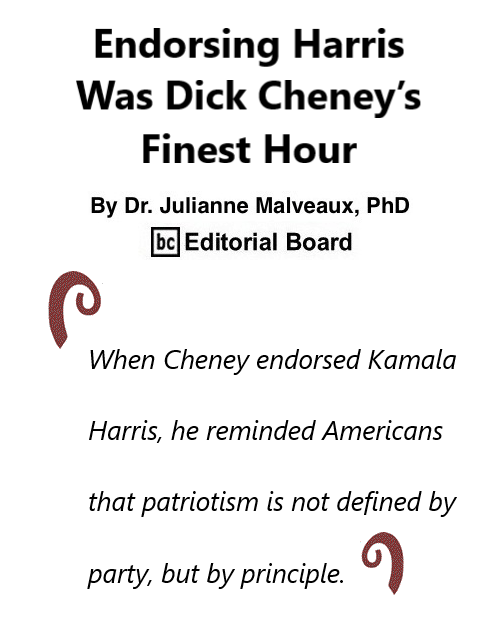
When
Cheney endorsed Kamala Harris, he reminded
Americans that patriotism is not defined by
party, but by principle. His death closes a
tumultuous chapter in Republican history, one
where courage became a rare commodity. Cheney
was never a man who sought applause; he often
thrived on controversy. But in the end, he
stood for something larger than politics.
For
all his faults - and there were many - Dick
Cheney’s final years revealed the flicker of a
statesman’s soul. His defiance of Trump, his
defense of democracy, and his willingness to
speak uncomfortable truths earned him a
measure of redemption. When he endorsed Kamala
Harris, he stood not just against a man, but
against the corruption of a movement. In that
moment, Dick Cheney - the architect of hard
power - showed moral strength. And for that,
history may judge it, rightly, as his finest
hour. Speaker Mike Johnson (R-La.) and his
despotic minions have less than a fraction of
Cheney’s moral courage.