Given
all the political drama that has saturated
the nation for the better
part of the last few years, it should hardly
come as a revelation
that the heated rhetoric dominating the
public discourse has alarmed
many Americans. A Gallup poll released on
December 3 revealed that
the majority of voters of the nation’s two
major political parties
believe acerbic, inflammatory criticism and
vile, cruel political
language has gone too far. Not surprisingly,
voters on either side of
the political spectrum are more inclined to
believe the opposing
party has been more extreme in spouting such
rhetoric. There is also
widespread consensus that this rhetoric and
the growing hostility
that accompanies it is dramatically
augmenting political violence.
The poll was conducted between October 1 and
16, a few weeks after
conservative activist Charlie Kirk was
shot and killed
during an event at Utah Valley University.
Jeffrey
Jones, a Gallup employee, wrote in an
analysis
of the poll, “Gallup said it used questions
similar to what it
asked in a poll 14 years ago, after former
U.S. Rep. Gabrielle
Giffords was
shot
during a 2011 political event. A larger
majority of Americans than in
the past believe that both the Democratic
and Republican parties and
their supporters have gone too far in using
inflammatory language to
criticize their opponents.”
69%
say this about the Republican Party and
Republicans and 60% say it
about the Democratic Party and Democrats, a
16% and 9% point increase
from 2011.
Partisans
are generally in agreement about the major
causes of political
violence:
-
Two-thirds or more Republicans,
Democrats, and independents say the spread
of extremist views on the internet
deserves a great deal of blame for
political violence, with Democrats most
likely to say so (79%).
-
Democrats (72%) are also more
likely than Republicans (58%) and
independents (63%) to see provocative
oratory from political leaders as a major
cause of political violence.
-
Slim majorities of the three
party groups (between 51% and 54%) blame
the mental health system’s failure to
identify dangerous individuals as a major
reason for political violence.
Democrats
and Republicans demonstrate stark differences
in their perceptions of
whether easy gun access is a primary factor
for the recent spate of
political violence (74% of Democrats vs. 14%
of Republicans).
Republicans are more prone than Democrats and
independents to
consider drug use, inadequate public security,
and media violence as
the primary factors.
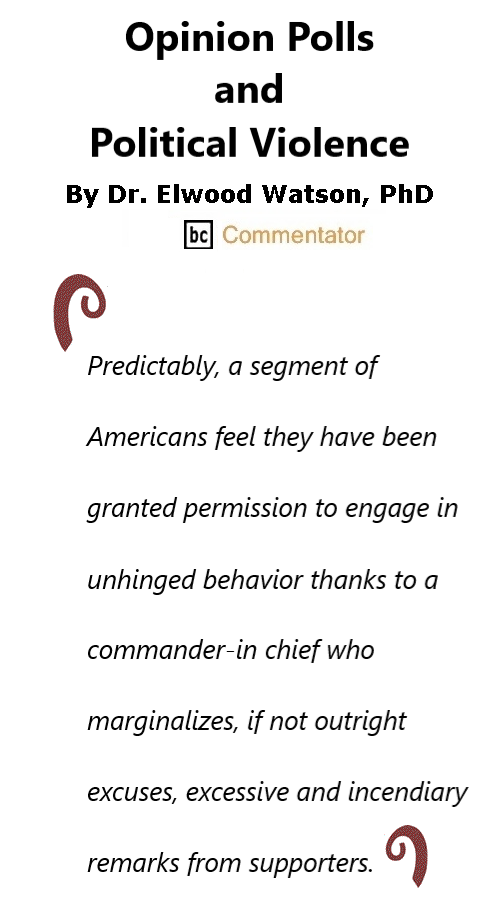
Predictably,
a segment of Americans feel they have been
granted permission to
engage in unhinged behavior thanks to a
commander-in chief who
marginalizes, if not outright excuses,
excessive and incendiary
remarks from supporters. Trump has himself
done things like singling
out a young female reporter by attacking
her
appearance.
Meanwhile,
his vice president has described a group of
Republican operatives
using scurrilous, racist, anti-Semitic, and
homophobic idiom as
“young
people doing stupid things”
These operatives ranged from 30 to 42 years
old.
A
great deal of people tend to take their cues
from those at the top of
the political hierarchy. Left-wing bombast
can be inappropriate,
vile, callous, and unacceptable, including comparing
all Republicans to Nazis and labeling all
Trump supporters as
“garbage.”
Neither side has a monopoly on crass
verbiage that is worthy of
denunciation.
Astringent
political hyperbole has been a part of the
fabric of this nation
since its inception. Nevertheless, we are at
an inflection point.
Sober adults must make a good-faith effort to
temper their comments
by using more diplomacy and less hyperbole.
They must remember that
future generations in America and the rest of
the world are watching
and learning from them.
|