We
are
living in a time of deep and dangerous
instability. Wars are threatened or
underway, democratic norms are eroding, and
economic inequality is no longer episodic -
it is structural. Historian Margaret
MacMillan
calls moments like this ones of radical
uncertainty:
periods when old assumptions no longer hold,
power is shifting, and leaders respond less
with wisdom than with force.
As
we
mark the birthday of Martin
Luther
King Jr.,
it is worth remembering that King did not
ask to be praised once a year. He asked to
be heard - and acted upon.
In
1967,
King offered a diagnosis that still
unsettles. He warned that the United States
was imperiled by a triple
threat:
racism,
materialism,
and militarism.
These were not separate sins. They were a
governing system. Racism determined whose
lives mattered least. Materialism elevated
profit over people. Militarism enforced both
at home and abroad. Together, they hollowed
out democracy while pretending to defend it.
That framework fits our moment with
uncomfortable precision.
Racism is now routinely denied even
as it structures outcomes. It appears in
persistent racial wealth gaps, in
environmental sacrifice zones, in policing
and incarceration, and in who is most likely
to be asked to fight America’s wars.
Materialism - King’s term, not mine -
measures national success by markets rather
than human well-being. It tolerates
billionaires alongside homelessness, medical
debt, and food insecurity. Militarism then
becomes the default response to uncertainty,
swallowing public resources while social
needs are met with lectures about scarcity.
Look
at
U.S. foreign policy and the pattern is
unmistakable. In the Western Hemisphere,
pressure campaigns and regime-change
fantasies aimed at Venezuela, deepened
military cooperation and “advisory”
footprints in Colombia, and the
enduring intervention reflex toward Cuba treats
sovereignty as provocation. These are not
declared wars. They are the quieter,
bureaucratized forms of militarism King
warned us about - sanctions that function as
siege, security assistance that invites
escalation, and rhetoric that replaces
diplomacy with dominance.
The
same
logic travels. Strategic attention to Greenland - wrapped in
Arctic competition and resource access -
shows how militarism now adapts to climate
change, recasting melting ice as a security
opportunity. And in Iran, the United
States continues to circle confrontation
through sanctions, proxy conflict, and the
ever-present threat of force, despite
knowing that a direct war would be
catastrophic. Instability is treated not as
a warning, but as justification.
King
insisted
that militarism does not merely destroy
lives abroad; it distorts
democracy at home.
A nation perpetually prepared for war, he
argued, cannot fully commit to justice.
Budgets confirm the point. There is always
money for weapons systems, overseas bases,
and contingency plans. There is rarely
enough for housing, schools, or health care.
Scarcity, in this context, is a political
choice.
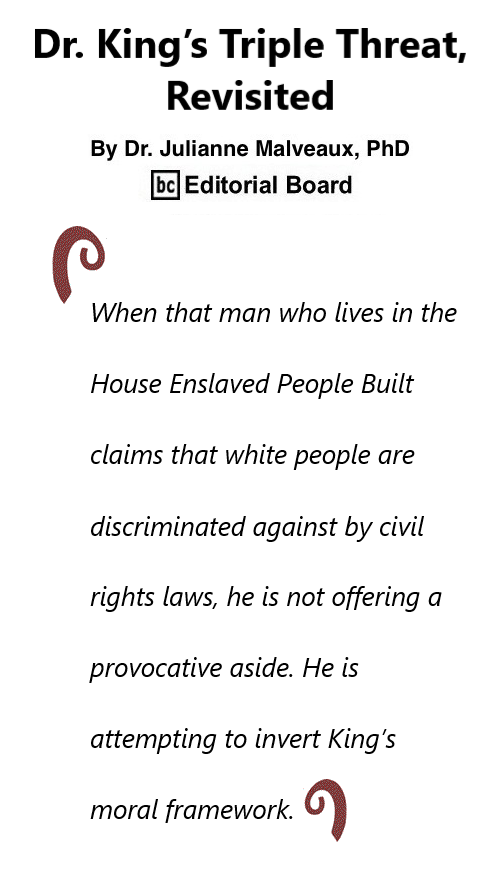
That is why rhetoric matters. When
that man who lives in the House Enslaved
People Built claims that white people are
discriminated against by civil rights laws,
he is not offering a provocative aside. He
is attempting to invert King’s moral
framework. Civil rights laws were designed
to dismantle legally enforced exclusion and
violence. To recast them as discriminatory
is to deny the structural nature of racism
and to sanctify accumulated advantage as
merit. This inversion strengthens the triple
threat by denying racism, glorifying
material advantage, and legitimizing
coercion in the name of “order.”
Radical uncertainty sharpens these
tendencies. When leaders feel unmoored, they
reach for militarism and nostalgia -
promising safety through force and stability
through hierarchy. King rejected that reflex
outright. He argued that uncertainty becomes
dangerous only when it is managed through
domination rather than repair.
Racism decides who pays.
Materialism decides who profits. Militarism
enforces both. Break one link and the system
strains; leave all three intact and
injustice persists with administrative
efficiency.
King’s alternative was not
sentimental. It was rigorous. He called for
redistribution alongside rights, peace
alongside prosperity, and democratic
accountability alongside security. The Poor
People’s Campaign was not a detour from
civil rights; it was the logical conclusion
of his analysis.
MacMillan’s
radical
uncertainty
names the moment. King’s triple
threat
explains why it feels so perilous. The
question before us is not whether
uncertainty will pass - it will not - but
whether we will continue to manage it by
denying racism, worshiping material
accumulation, and normalizing militarism,
from Latin America to the Arctic, from the
Middle East back home.
King warned where that road leads.
He also told us how to choose differently.