The United States insists it cannot
afford housing, jobs, or care. Yet it can
always afford cages. Immigration enforcement
is not a response to crisis; it is a
budgetary preference. Billions are reliably
available to detain, transport, and deport
people, even as Black communities are told
to be patient, resilient, and fiscally
realistic.
Immigration and Customs Enforcement
- ICE - embodies that choice. Its budget has
ballooned over two decades, underwriting
detention centers, surveillance
technologies, transportation contracts, and
a growing enforcement workforce. This
spending does not meaningfully enhance
public safety. It sustains an enforcement
economy - private detention operators,
logistics firms, and surveillance
contractors - that profits from fear and
instability.
Every dollar spent on ICE is not
merely unavailable elsewhere; it is taken
away from housing stabilization, workforce
development, mental health care, violence
interruption, and youth employment. Scarcity
is not the problem. Priorities are.
ICE’s economic function is as
important as its legal one. Immigration
enforcement operates as a labor-control
strategy. By making workers deportable,
raids and threats suppress wages, fracture
organizing, and discipline entire industries
- construction, food processing, care work,
hospitality - where Black and immigrant
workers are concentrated. A workforce that
can be removed cannot bargain.
This does not create jobs for Black
workers. It does the opposite. When wages
are pushed down at the bottom, Black workers
are pulled down too. Employers benefit from
fear; workers absorb the loss. Immigration
crackdowns don’t lift Black employment -
they weaken bargaining power and call it
order.
The claim that ICE does not affect
Black people collapses under scrutiny. Black
immigrants - particularly African and
Caribbean - are disproportionately detained
and deported, often because minor criminal
records shaped by racially biased policing
become removal triggers. Detention is
longer. Bond is less likely. Civil
immigration law borrows the harshest tools
of the criminal legal system and applies
them selectively.
Black Americans recognize this
system because we have lived under its
predecessors. Long before ICE, the state
developed mechanisms to control movement,
suppress resistance, and protect an economic
order built on exploitation. Slave patrols
enforced racial boundaries and labor
discipline. After emancipation, vagrancy
laws and convict leasing carried the work
forward. In the twentieth century, mass
incarceration normalized punishment as
policy. ICE belongs squarely in this
lineage.
The uniforms have changed. The
logic has not.
And
that logic does not remain neatly
contained. Enforcement systems
always expand beyond their stated
targets. In Minnesota, ICE agents
broke into the home of ChongLy
Scott
Thao,
a 56-year-old Asian American man
and U.S. citizen, dragged him
outside in his underwear in
freezing weather, and detained him
for nearly an hour. He was
returned with no charges, no
explanation, and no apology. This
was not a clerical error. It was a
demonstration of power.
Black Americans recognize this move
immediately. We know what happens when
suspicion overrides citizenship, when force
precedes explanation, and when the state
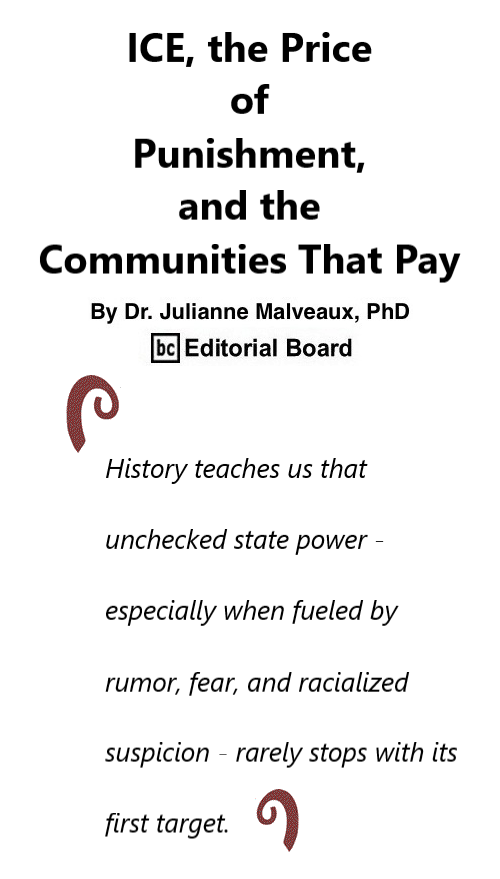
decides accountability is optional. History
teaches us that unchecked state power -
especially when fueled by rumor, fear, and
racialized suspicion - rarely stops with its
first target.
This
expansion becomes even more
dangerous when enforcement
collides with dissent. In
Minneapolis, the killing of legal
observer Renée
Good during
an
ICE operation sparked protest and
public criticism of federal
tactics. The federal response -
scrutiny of officials who spoke
out - sent a familiar message:
criticize enforcement and expect
retaliation. Protest becomes
threat. Speech becomes suspect.
Black communities have heard this
warning before. From civil-rights marches to
protests against police violence, Black
political expression has repeatedly been met
with surveillance and discipline.
Immigration enforcement is simply the latest
arena where that muscle is being exercised.
The scale of this system matters.
ICE now employs roughly 22,000 officers and
agents, up from about 17,000 at its creation
in 2003. Budgets exceed $10 billion
annually, with tens of billions more
authorized for detention, deportation,
transportation, and surveillance. Roughly
70,000 people are detained at any given
time, most with no criminal conviction.
Meanwhile, Black communities are told there
is no money - for housing, jobs, schools, or
health care. No money to uplift people, but
plenty for punishment, including large
signing bonuses to rapidly expand
enforcement capacity without commensurate
accountability.
This
is
not inevitability. It is choice.
A nation that funds removal more
readily than repair is not
preserving order - it is
enforcing hierarchy. ICE’s
budget tells us exactly who this
country is willing to invest in
and who it is willing to
endanger, dispossess, or
disappear. Black communities
recognize this pattern because
we have survived it
before. Power
exercised
without accountability never
stops on its own.