Labor
economists
like me mark our calendars for the first
Friday of each month, when the Bureau of
Labor Statistics releases The
Employment
Situation.
In February, that report did not arrive on
schedule. According to BLS, a partial
government shutdown temporarily suspended
data processing and dissemination, delaying
the January jobs report.
Many economists have built careers
around these numbers, and we are right to
rely on them. But moments like this also
remind us that labor statistics are produced
within institutions that are meant to be
independent, but are not immune to political
pressure. The Commissioner of Labor
Statistics is appointed by the president and
confirmed by the Senate to a four-year term.
While the position is designed to be
apolitical, recent disruptions have
underscored how fragile public trust in
economic data can be.
Still, we do not need official
numbers to know that many workers -
especially Black workers - are living
through an era of fragile employment.
Federal layoffs, private-sector
retrenchment, reduced hours, frozen hiring,
and stalled mobility are being felt long
before they are fully captured in headline
data.
Recent
job
growth has been weak by historical
standards. Gains have slowed markedly over
the last several months, reinforcing a sense
of economic brittleness despite political
claims of strength. The official
unemployment rate, 4.4
percent
in December,
appears low - but it does not tell the whole
truth.
It
excludes
discouraged workers who have stopped looking
for jobs. It excludes people working part
time who want full-time hours. The Bureau of
Labor Statistics’ broader measure of labor
underutilization - which captures these
realities - stood at 8.4
percent
in December.
Historically,
Black
unemployment runs well above the overall
rate, and that relationship has been
remarkably consistent across business
cycles. Applying that same pattern to
underutilization yields what I call the Malveaux Index: an estimated
Black labor underutilization rate of approximately
14.3 percent.
This is not an official statistic, but a way
of amplifying what headline numbers obscure
- that labor market “strength” looks very
different depending on where one stands.
For Black workers, this level of
underutilization is recession-level
distress. But no index is required to
recognize what many Black Americans are
already living.
For generations, Black labor has
functioned as an early warning system for
economic distress. When jobs disappear,
hours are cut, or wages stall, Black workers
experience it first and most intensely - not
because of individual failings, but because
the structure of the labor market places
them closest to its fault lines.
Today’s fragility is not always
announced by mass layoffs. It shows up
quietly: in shortened schedules,
unpredictable shifts, frozen promotions, and
the constant anxiety that accompanies each
paycheck. A worker can be technically
“employed” and still be economically
insecure. A job can exist without providing
dignity, stability, or a future.
This is where official statistics
fall short - and where Black narrative steps
in.
Black workers are
disproportionately concentrated in retail,
hospitality, caregiving, transportation,
logistics, and public-facing service work.
In these sectors, employers often cut hours
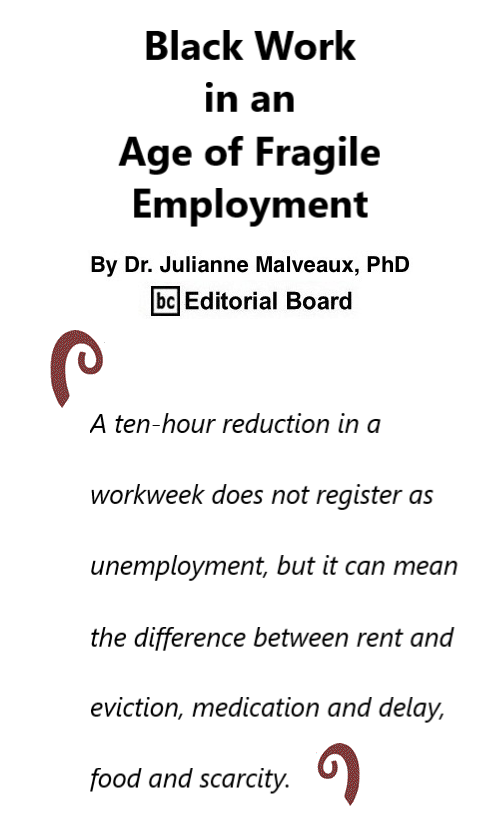
before cutting jobs. A ten-hour reduction in
a workweek does not register as
unemployment, but it can mean the difference
between rent and eviction, medication and
delay, food and scarcity.
Data rarely captures fear. It does
not measure exhaustion. It does not record
the psychic toll of holding onto work that
no longer pays enough to live, or the
humiliation of being grateful for employment
that offers no path forward.
This is why Black literature, Black
journalism, and Black cultural institutions
matter so profoundly in this moment. Long
before economists spoke of “hidden
unemployment” or “labor market slack,” Black
writers documented the truth of work under
constraint - jobs that damaged bodies, wages
that never caught up, and systems designed
to extract labor without offering security
in return.
From early twentieth-century
narratives of agricultural labor to
contemporary writing on gig work, care
labor, and economic survival, Black writers
have chronicled labor not as abstraction but
as lived condition. They have shown how
race, class, gender, and geography shape who
works, who waits, and who is discarded when
conditions tighten.
A low unemployment rate does not
signal a healthy labor market if workers
cannot move, cannot bargain, and cannot
survive on what they earn. A stable job
count does not mean stability if wages lag
inflation and savings have already been
depleted. An economy that leaves Black
workers anxious, immobile, and overworked is
not strong - it is brittle.
Work has never been just work for
Black Americans. It is bound up with
dignity, citizenship, survival, and voice.
When the jobs report misleads - or goes
missing altogether - it is Black work, in
all its forms, that tells the truth.