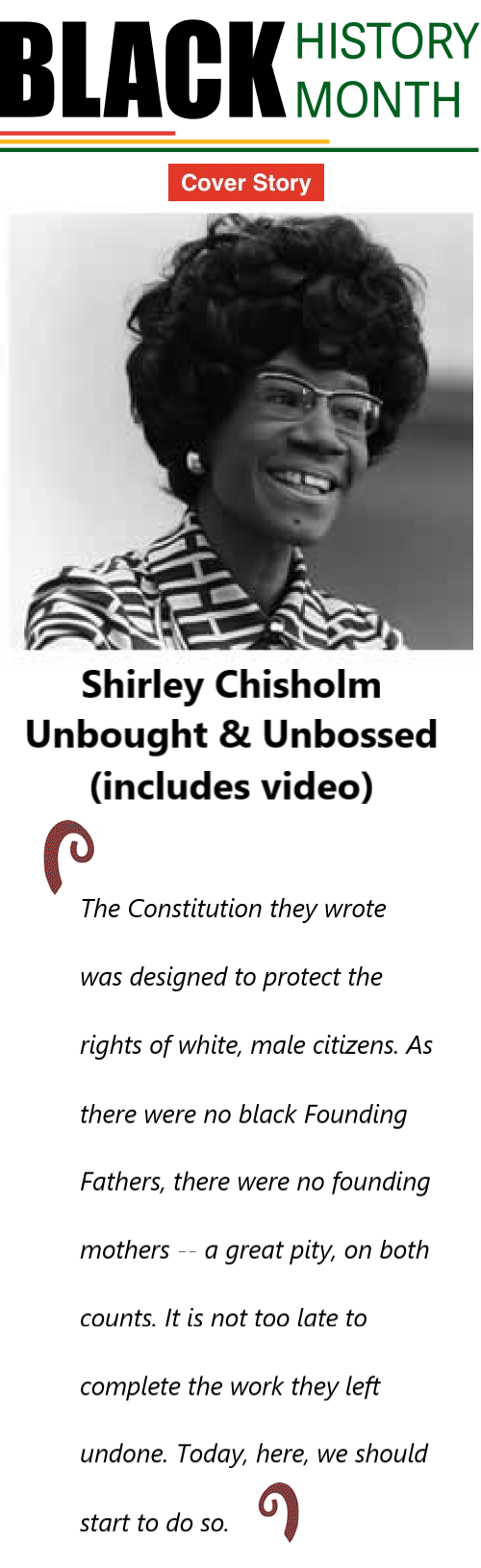
One of Ms.
Chisholm’s most famous speeches was in support
of the Equal Rights Amendment. It was
delivered August 10, 1970 in Washington, DC
before the House of Representatives. The
complete text follows.
Mr.
Speaker,
House Joint Resolution 264, before us today,
which provides for equality under the law
for both men and women, represents one of
the most clear-cut opportunities we are
likely to have to declare our faith in the
principles that shaped our Constitution. It
provides a legal basis for attack on the
most subtle, most pervasive, and most
institutionalized form of prejudice that
exists. Discrimination against women, solely
on the basis of their sex, is so widespread
that is seems to many persons normal,
natural and right.
Legal
expression
of prejudice on the grounds of religious or
political belief has become a minor problem
in our society. Prejudice on the basis of
race is, at least, under systematic attack.
Their is reason for optimism that it will
start to die with the present, older
generation. It is time we act to assure full
equality of opportunity to those citizens
who, although in a majority, suffer the
restrictions that are commonly imposed on
minorities, to women.
The
argument
that this amendment will not solve the
problem of sex discrimination is not
relevant. If the argument were used against
a civil rights bill, as it has been used in
the past, the prejudice that lies behind it
would be embarrassing. Of course laws will
not eliminate prejudice from the hearts of
human beings. But that is no reason to allow
prejudice to continue to be enshrined in our
laws -- to perpetuate injustice through
inaction.
The
amendment
is necessary to clarify countless
ambiguities and inconsistencies in our legal
system. For instance, the Constitution
guarantees due process of law, in the 5th
and 14th amendments. But the applicability
of due process of sex distinctions is not
clear. Women are excluded from some State
colleges and universities. In some States,
restrictions are placed on a married woman
who engages in an independent business.
Women may not be chosen for some juries.
Women even receive heavier criminal
penalties than men who commit the same
crime. What would the legal effects of the
equal rights amendment really be? The equal
rights amendment would govern only the
relationship between the State and its
citizens -- not relationships between
private citizens. The amendment would be
largely self-executing, that is, and Federal
or State laws in conflict would be
ineffective one year after date of
ratification without further action by the
Congress or State legislatures.
Opponents
of
the amendment claim its ratification would
throw the law into a state of confusion and
would result in much litigation to establish
its meaning. This objection overlooks the
influence of legislative history in
determining intent and the recent activities
of many groups preparing for legislative
changes in this direction.
State
labor
laws applying only to women, such as those
limiting hours of work and weights to be
lifted would become inoperative unless the
legislature amended them to apply to men. As
of early 1970 most States would have some
laws that would be affected. However,
changes are being made so rapidly as a
result of title VII of the Civil Rights Act
of 1964, it is likely that by the time the
equal rights amendment would become
effective; no confliction State laws would
remain.
In
any
event, there has for years been great
controversy as to the usefulness to women of
these State labor laws. There has never been
any doubt that they worked a hardship on
women who need or want to work overtime and
on women who need or want better paying
jobs, and there has been no persuasive
evidence as to how many women benefit from
the archaic policy of the laws. After the
Delaware hours law was repealed in 1966,
there were no complaints from women to any
of the State agencies that might have been
approached.
Jury
service
laws not making women equally liable for
jury service would have been revised. The
selective service law would have to include
women, but women would not be required to
serve in the Armed Forces where they are not
fitted any more than men are required to
serve. Military service, while a great
responsibility, is not without benefits,
particularly for young men with limited
education or training.
Since
October
1966, 246,000 young men who did not meet the
normal mental or physical requirements have
been given opportunities for training and
correcting physical problems. This
opportunity is not open to their sisters.
Only girls who have completed high school
and meet high standards on the educational
test can volunteer. Ratification of the
amendment would not permit application of
higher standards to women.
Survivorship
benefits
would be available to husbands of female
workers on the same basis as to wives of
male workers. The Social Security Act and
the civil service and military service
retirement acts are in conflict. Public
schools and universities could not be
limited to one sex and could not apply
different admission standards to men and
women. Laws requiring longer prison
sentences for women than men would be
invalid, and equal opportunities for
rehabilitation and vocational training would
have to be provided in public correctional
institutions. Different ages of majority
based on sex would have to be harmonized.
Federal, State, and other governmental
bodies would be obligated to follow
nondiscriminatory practices in all aspects
of employment, including public school
teachers and State university and college
faculties.
What
would
be the economic effects of the equal rights
amendment? Direct economic effects would be
minor. If any labor laws applying only to
women still remained, their amendment or
repeal would provide opportunity for women
in better-paying jobs in manufacturing. More
opportunities in public vocational and
graduate schools for women would also tend
to open up opportunities in better jobs for
women.
Indirect
effects
could be much greater. The focusing of
public attention on the gross legal,
economic, and social discrimination against
women by hearings and debates in the Federal
and State legislatures would result in
changes in attitude of parents, educators,
and employers that would bring about
substantial economic changes in the long
run.
Sex
prejudice
cuts both ways. Men are oppressed by the
requirements of the Selective Service Act,
by enforced legal guardianship of minors,
and by alimony laws. Each sex, I believe,
should be liable when necessary to serve and
defend this country. Each has a
responsibility for the support of children.
There
are
objections raised to wiping out laws
protecting women workers. No one would
condone exploitation. But what does sex have
to do with it. Working conditions and hours
that are harmful to women are harmful to
men; wages that are unfair for women are
unfair for men. Laws setting employment
limitations on the basis of sex are
irrational, and the proof of this is their
inconsistency from State to State. The
physical characteristics of men and women
are not fixed, but cover two wide spans that
have a great deal of overlap. It is obvious,
I think, that a robust woman could be more
fit for physical labor than a weak man. The
choice of occupation would be determined by
individual capabilities, and the rewards for
equal works should be equal.
This
is
what it comes down to: artificial
distinctions between persons must be wiped
out of the law. Legal discrimination between
the sexes is, in almost every instance,
founded on outmoded views of society and the
pre-scientific beliefs about psychology and
physiology. It is time to sweep away these
relics of the past and set further
generations free of them.
Federal
agencies
and institutions responsible for the
enforcement of equal opportunity laws need
the authority of a Constitutional amendment.
The 1964 Civil Rights Act and the 1963 Equal
Pay Act are not enough; they are limited in
their coverage -- for instance, one excludes
teachers, and the other leaves out
administrative and professional women. The
Equal Employment Opportunity Commission has
not proven to be an adequate device, with
its power limited to investigation,
conciliation, and recommendation to the
Justice Department. In its cases involving
sexual discrimination, it has failed in more
than one-half. The Justice Department has
been even less effective. It has intervened
in only one case involving discrimination on
the basis of sex, and this was on a
procedural point. In a second case, in which
both sexual and racial discrimination were
alleged, the racial bias charge was given
far greater weight.
Evidence
of
discrimination on the basis of sex should
hardly have to be cited here. It is in the
Labor Department’s employment and salary
figures for anyone who is still in doubt.
Its elimination will involve so many changes
in our State and Federal laws that, without
the authority and impetus of this proposed
amendment, it will perhaps take another 194
years. We cannot be parties to continuing a
delay. The time is clearly now to put this
House on record for the fullest expression
of that equality of opportunity which our
founding fathers professed. They professed
it, but they did not assure it to their
daughters, as they tried to do for their
sons.
The
Constitution
they wrote was designed to protect the
rights of white, male citizens. As there
were no black Founding Fathers, there were
no founding mothers -- a great pity, on both
counts. It is not too late to complete the
work they left undone. Today, here, we
should start to do so.
In
closing
I would like to make one point. Social and
psychological effects will be initially more
important than legal or economic results. As
Leo Kanowitz has pointed out:
Rules of law that treat of the
sexes per see inevitably produce
far-reaching effects upon social,
psychological and economic aspects of
male-female relations beyond the limited
confines of legislative chambers and
courtrooms. As long as organized legal
systems, at once the most respected and
most feared of social institutions,
continue to differentiate sharply, in
treatment or in words, between men and
women on the basis of irrelevant and
artificially created distinctions, the
likelihood of men and women coming to
regard one another primarily as fellow
human beings and only secondarily as
representatives of another sex will
continue to be remote. When men and women
are prevented from recognizing one
another’s essential humanity by sexual
prejudices, nourished by legal as well as
social institutions, society as a whole
remains less than it could otherwise
become.
For more information about Shirley
Chisholm,
click here.
The
following words comprise the entire text of
the Equal Rights Amendment (ERA), affirming
the equal application of the U.S.
Constitution to both females and
males.
Section 1.
Equality of rights under the law shall not
be denied or abridged by the United States
or by any state on account of sex.
Section 2.
The Congress shall have the power to
enforce, by appropriate legislation, the
provisions of this article.
Section 3.
This amendment shall take effect two years
after the date of ratification.
The
ERA
was written in 1923 by Alice Paul,
suffragist leader and founder of the
National Woman's Party. She and the
NWP considered the ERA to be the next
necessary step after the 19th Amendment
(affirming women's right to vote) in
guaranteeing "equal justice under law" to
all citizens.
The
ERA
was introduced into every session of
Congress between 1923 and 1972, when it was
passed and sent to the states for
ratification. The seven-year time limit in
the ERA's proposing clause was extended by
Congress to June 30, 1982, but at the
deadline, the ERA had been ratified by 35
states, leaving it three states short of the
38 required for ratification. It has been
reintroduced into every Congress since that
time.
For
a
more comprehensive historical account of
the ERA, Click
here.