It
is possible that watermelons are both a
symbol of racism for Black
people in America and a symbol of solidarity
and empowerment for
Palestinians. There is a story behind this.
It
all came to light recently when the New
York City chapter of the
Democratic Socialists of America posted a
flier
targeting Rep. Hakeem Jeffries, D-N.Y.,
and calling for a ceasefire
in Gaza. The flier featured a drawing of a
watermelon with the
message: “Make art outside Hakeem
Jeffries’ Office.” The flier
of a watermelon aimed at a Black lawmaker
angered some in the Black
community, and understandably so.
Black
folks have a love-hate relationship with
watermelon. Many of us love
to eat the sweet and juicy fruit, but
drawings and depictions of
watermelon trigger us and make us feel some
sort of way. Why is that?
This wasn’t always the case.
Black
people take offense to the watermelon
imagery because of the role
watermelon has played in our own
racialized oppression, particularly
since after the Civil War. Watermelon
dates
back to Africa,
and while the racist imagery linking Black
people with watermelons
was present during enslavement, watermelon
was first associated with
Arab and Italian peasants in the early
19th century. In America,
watermelons were a symbol of Black
freedom
and self-sufficiency
when the formerly enslaved grew and sold
them after emancipation. For
the white supremacist power structure,
this was a threat to the
racial order and white power.
During
Jim Crow, white people amplified the
watermelon as a cartoonish
symbol of Black denigration, inferiority,
laziness, childishness,
uncleanliness and other racial
stereotypes. Watermelon became a white
supremacist trope and epithet, a toxic
representation of blackness
that far too many Black people have
internalized. A healthy
fruit
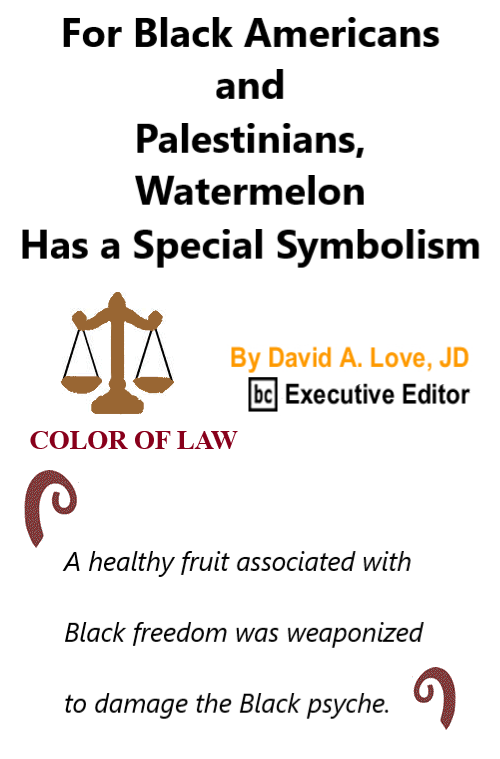
associated with Black freedom was
weaponized to damage the Black
psyche.
As
the Jim
Crow Museum
at Ferris State University has chronicled,
the grotesque imagery
promoted by white Jim Crow society of
caricatured Black faces with
googly eyes and dark skin, bright red lips
and tattered clothes
eating watermelons took its toll on the
self-esteem of Black people.
Newspapers
and
postcards
during the Jim Crow era promoted
caricatures of watermelon-eating
Black people, associating the fruit with
free Black people. Films
such as “The Birth of a Nation” and the
animated “Scrub Me Mama
with a Boogie Beat” featured Black people
eating watermelon and
helped to amplify and solidify these
stereotypes in the white
consciousness. These denigrating images
meant to embarrass Black
people and make them look silly, stupid,
messy and carefree are a
reason why some Black people refuse to eat
watermelons to this day -
and in
front of white people.
Even
in the present-day media landscape and
popular culture, the damaging
watermelon imagery continues, and Black
folks can’t seem to shake
it off.
A
symbol of Jim Crow for Black people in the
United States, the
watermelon assumed a different, powerful
symbolism
for Palestinians living under the
apartheid military occupation of
Israel. When Israel seized control of the
West Bank and Gaza in 1967
and criminalized displaying the red,
black, green and white
Palestinian flag, Palestinians adopted the
watermelon as a workaround
(as a point of reference, the Black
nationalist flag is red, black
and green).
The
flag ban was lifted in 1993, but the
watermelon remained a potent
icon of Palestinian
solidarity.
Plus, Israeli police will still snatch
a
Palestinian flag
and make arrests. And pro-Palestinian
users even adopted the
watermelon emoji to overcome what they
believe are content
restrictions on social media.
Watermelon
symbolism reflects the struggles for freedom
and fights against
oppression for African-Americans and
Palestinians. Today, that
symbolism lands quite differently for Black
people in America and for
Palestinians living under Israeli
occupation. Jim Crow America
weaponized the watermelon against Black
people as a backlash against
emancipation and Black empowerment.
Palestinians adopted the
watermelon as a symbol of empowerment and
solidarity. But we must
acknowledge these differences and hold both
realities at the same
time.