How
Federal
Reserve policy lands hardest
on those at the margins
By
May 15, the Federal Reserve will likely have
a new chair. That
transition is more than routine; it reflects
a deeper tension about
what the Fed is supposed to do and whom it
is supposed to serve.
For
years, the president has publicly criticized
current chair, Jerome
Powell, arguing that interest rates should
have been lowered more
aggressively to stimulate economic growth.
Powell has resisted,
warning that lowering rates too quickly
could fuel inflation. That
disagreement captures a central challenge
for the Fed. Its mandate is
to stabilize the economy using monetary
policy, but stability is not
a single goal. It includes both controlling
inflation and supporting
a strong labor market, and those goals can
conflict.
The
president has now nominated Kevin Warsh to
serve as chair, and he is
likely to be confirmed by the full Senate on
or before Powell’s
term ends. But the nomination has not been
without controversy.
Senator Elizabeth Warren and others have
raised concerns that Warsh’s
closeness to the president could undermine
the independence of the
Fed - an institution that is supposed to
operate free from political
pressure.
Why
should you care?
Because
what can seem like a technical debate in
Washington has very real
consequences beyond it. It is about who
shapes the policies that
determine the cost of borrowing, the
availability of jobs, and the
pace of economic growth. The Fed’s decisions
ripple outward -
affecting everything from mortgage rates to
small business lending to
whether employers are hiring or laying off.
And those effects are not
evenly distributed.
For
millions of Americans, and especially for
Black people, the Fed’s
decisions are not abstract. They are
immediate, material, and deeply
felt in paychecks, rent, and job security.
When the Fed raises
interest rates, it is trying to slow
inflation. In practice, however,
higher rates also slow hiring, weaken wage
growth, and increase the
risk of layoffs. Black workers are more
likely to feel those effects
first, not because they are less capable,
but because they are more
often positioned at the margins of the labor
market: last hired,
first fired, and concentrated in sectors
most vulnerable to economic
shifts.
Out
of more than 150 people who have occupied
the highest ranks of the
Federal Reserve over the past century, only
about six have been Black
- roughly 4 percent in a country where Black
people make up about 13
percent of the population. Neutrality looks
different when the people
making decisions do not reflect the people
living with the
consequences. Representation does not
guarantee different outcomes,
but absence almost certainly limits
perspective.
Black
Americans experience monetary policy not
through economic models but
through the cost of borrowing and the
availability of work. When
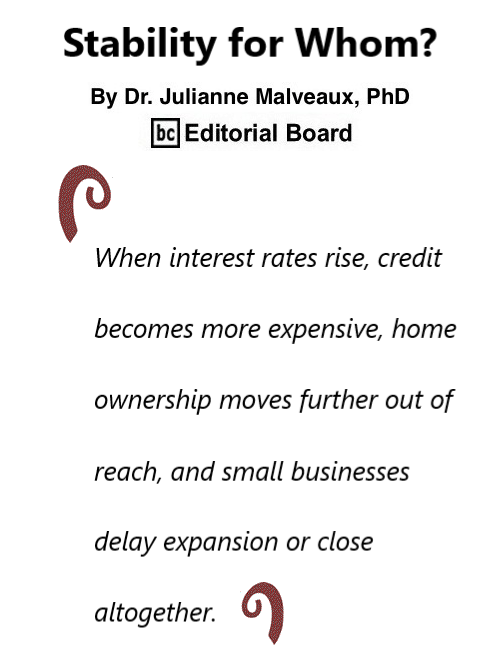
interest rates rise, credit becomes more
expensive, home ownership
moves further out of reach, and small
businesses delay expansion or
close altogether. As employers begin to pull
back, layoffs rarely
begin with the most secure workers. They
begin at the margins, where
Black workers are too often concentrated.
Even
in strong economic times, Black Americans
face higher unemployment,
lower wages, and significantly less
accumulated wealth than their
white counterparts. When the Fed tightens
policy, those disparities
do not disappear; they deepen. A central
bank that prioritizes
inflation above all else may succeed in
stabilizing prices, but it
can also tolerate higher unemployment - and
if that unemployment
falls disproportionately on certain
communities, then stability
itself becomes unevenly distributed.
There
is also a deeper history that rarely enters
these conversations. The
Federal Reserve was created in 1913, at a
time when Black Americans
were largely excluded from the formal
financial system. Black banks
emerged out of necessity because mainstream
institutions denied
access to credit. Redlining and federal
policy expanded opportunity
for some while systematically excluding
others, leaving behind
disparities that remain visible today.
When
policymakers decide how aggressively to
fight inflation, they are
also deciding how much unemployment they are
willing to accept and
who is most likely to bear that cost. These
are not neutral
calculations. They are choices embedded in a
broader history of
unequal access to opportunity and security.
The
Federal Reserve may prefer the language of
neutrality, but the
reality is more complicated. When
policymakers choose how to balance
inflation and employment, they are choosing
who bears the cost of
economic stability. Those are not neutral
calculations. They are
choices.
The
question is not whether the Fed is
political. It is whether we are
willing to insist that its definition of
stability includes everyone.