Even
in death, Michael Jackson stokes controversy.
Like millions of other
people, I decided to see the recent film, Michael.
Despite receiving abrasively
brutal
reviews,
the film has broken
the
record
for the biggest opening in biopic history and
garnered more than
$400m since its release, with a projected
profit of over $900m by the
end of its run. The film recounts Jackson’s
life, from the
inaugural pioneering days of the Jackson Five,
terrorized by
belt-wielding dad Joe, to his emergence as a
stunningly original,
globally adored solo act, culminating in the
colossal Wembley Stadium
concert in 1988, at which point he was
entering his thirtieth year of
life.
It
was notable how segments of the audience
recoiled when papa Joe
Jackson, adroitly performed by Colman Domingo,
beats a young Jackson
despite delivering a successful performance.
The initial reaction
emerged when Juliano Valdi, who admirably
plays ten-year-old Michael,
records lyrics for the first time for Motown
legend Berry Gordy.
Director Antoine Fuqua substituted the music
to spotlight raw vocals
from Valdi, who is so dramatically similar to
Jackson that several
fellow attendees gasped with admiration of the
young man’s vocal
abilities. Reaction was duplicated when the
adult version of Michael,
superbly played by his real-life nephew Jaafar
Jackson (Jermaine’s
son), ominously sounded like and deftly
captured his esteemed uncle’s
dancing moves.
Michael
is a specific narration of the singer’s life,
and this is a fact
that appeases more people than many of the
film’s critics think.
His business savvy was evident in how he
shrewdly worked with studio
executives and agents, making it clear he had
no intention of being
confined to being viewed solely as a “Black”
artist; rather, he
intended to be a universal artist who
transcoded all cultures. Other
actors enacting real-life people integral to
Jackson’s life
included Larenz Tate (who plays Motown record
label founder Berry
Gordy), Mike Meyers (who plays CBS Records
magnate Walter Yetnikoff),
and Nia Long (who plays Michael’s
long-suffering, loving, and
largely emotionally submissive mother
Katherine). Notably, the film
doesn’t refuse to expose how a young Michael
acquired some of his
odd behaviors in adulthood, including latent
obsessions with the
various trappings of childhood. Rather, the
movie showcases them for
laughs. I noticed that a number of audience
members laughed at the
antics of the animals he surrounds himself
with, from giraffes to his
longtime chimp friend Bubbles.
Okay.
I will be honest and come clean; I will
concede that I was a huge
Michael Jackson fan! From the time I was a
teenager, I rabidly
purchased all of his albums. As I see it, even
today as a late
middle-aged man, he was one of the greatest
entertainers to ever
live. To this very day, I still harbor that
assessment. In fact, on
the very evening of his passing on June 25,
2009, I received a call
from one of my siblings asking me how I was
feeling. She knew how
much I admired the King of Pop. Truth be told,
I was very saddened to
hear of his death. As I saw it, he was so
young, so vibrant, and
still had so much more to accomplish. Granted,
his life history was
far from serene, yet it certainly was nowhere
near as “tragic” or
“tormented” as some media pundits and
entertainment
correspondents argued at the time.
I
had followed the late Mr. Jackson from his
days as a member of the
Jackson Five when I was in elementary school
(my older siblings were
also huge fans) to his solo efforts with his
superb Off
the
Wall
(which, along with his fabulous Dangerous,
I believe were his best albums). Off
the Wall
went multiplatinum and made Jackson the first
artist to have four
songs from
the same album
reach the top 10!
As
if this was not significant enough, his next
album, “Thriller”,
produced six No. 1 songs, sold 40 million
copies, won at the time a
record-breaking
eight Grammy
Awards
(including Album
of the Year
and Record
of
the Year
for “Beat It”), and earned Jackson a record-breaking
eight American
Music
Awards.
It was the best-selling album of 1983
worldwide, and in 1984 it
became the first album to be the best-selling
in
the United States
for two straight years. It had an enormous
impact on the music
industry. In addition, in 1983, Jackson was
credited for
single-handedly reviving the music industry,
which prior to this
point underwent a major crisis as artists were
routinely being
dropped by record labels. Think about it. Even
if no other artist had
released any album that year, Michael Jackson
alone would have
revived an industry that up until that time
was in an economic funk!
Such a record is phenomenal. No one, not even
The Beatles, could
attest to such a feat.
It
was due to the phenomenal success of Michael
Jackson that MTV, which
up until this time catered to a predominantly
eighteen to
thirty-year-old White midwestern audience,
slowly but surely began to
give considerable airtime to Black artists,
including Prince, Tina
Turner, and Whitney Houston. Indeed, by the
late 1980s, MTV was
playing Black artists with frantic frequency,
even going so far as to
have a daily show titled, YO!
MTV
RAPS,
that aired on the network from August 1988 to
August 1995.
Most
of us have heard the story (the film alludes
to it as well) about how
MTV was initially resistant to playing
Jackson’s videos but
relented due to pressure from Walter
Yetnikoff, then-president of CBS
records, who threatened to pull all of his
artists from the music
channel if they refused to comply with his
demand. Whether such a
narrative is valid or the stuff of urban
legend, no one can dispute
the fact that such a decision was a wise and
lucrative one, both
financially and globally for MTV.
Let’s
face it, “Billie Jean,” “Beat It,” and,
needless to say,
“Thriller,” were among the most innovative
videos ever aired.
Jackson’s famous moonwalk and phenomenal
dancing prowess alone
prompted mid-twentieth century dancing legend
Fred
Astaire
to praise Jackson for his hoofing abilities.
Whether anyone wants to
acknowledge it or not, such consistent racial
inclusion and
transformation of a White-dominated industry
was largely due to
Michael Jackson.
Unfortunately,
rather
than focusing on such positive accomplishments
as his donating
millions of dollars to various charities and
altruistic efforts,
there are those - mostly detractors - who seem
more content to
ruminate on what they perceived as the
negative aspects of Jackson’s
life. They are the ones who take perverse
comfort in espousing
everything that was suspect or controversial
about Jackson. Examples
of such allegations include the following:
-
He was a self-hating Black man;
-
He was probably a pedophile;
-
He was a drug addict; and
-
His marriages were a sham.
And
the list goes on and on.
For
all of his supposed “reluctance” to embrace
his racial heritage,
unlike many Black entertainers (and some White
ones for that matter)
who are very influential and have substantial
multiracial followings,
Jackson did not hesitate to confront the issue
of race. Such cultural
impositions were evident in such songs as
“Black or White” and
“Heal the World.” This is in stark contrast to
many of his
supposedly “pro super Black” critics who
frequently have no
problem doing a number on White people in
private, but whose
militant, rhetorically racially conscious
backbones become spineless
marshmallows when in the presence of certain
Whites. There are
numerous examples of him shattering racial
barriers, stealthily and
brazenly promoting Black culture, and forcing
his doubters to concede
that he suffered from vitiligo.
The
same can be said for many of Jackson’s White
and other non-Black
critics who would often turn a blind eye;
adopt a “hear no evil,
see no evil, fear no evil” mindset; or even
wink at the deviant, in
some cases, pathological behavior of
celebrities of their own ethnic
group, but who had no problems in denouncing
Jackson as some “freak
of nature.” While Jackson did settle out of
court a lawsuit
alleging
(I stress the word allege) child molestation,
he did not admit to
guilt. In his 2005 trial, he was acquitted of
all charges by an
all-White jury. For decades, the public was
fed endless talking
points. In fact, Macaulay
Culkin
testified that Jackson never abused him and
later reaffirmed that
publicly. Emmanuel
Lewis
has defended Jackson repeatedly. Corey
Feldman
stated Jackson never acted inappropriately
toward him personally,
while also supporting alleged victims being
heard.
Additionally,
irrespective of numerous news accounts, all
throughout his
illustrious career, there was no hard evidence
that Michael Jackson
was a habitual user of drugs. In fact, it was
because of his image as
a drug-free celebrity (which was almost an
oxymoron in Hollywood
during the 1980s and mid-1990s) that he was
invited to the White
House in 1984 by then-president Ronald Reagan
to receive an award and
to serve as a spokesperson for former first
lady Nancy Reagan’s
“Just Say No” to drugs campaign.
There
were others who argued that, in spite of his
immense talents, his
love life was nonexistent and fraudulent, as
was evident in his
divorces. It was very peculiar that such
know-it-alls supposedly
seemed to know more about the intimate details
of Jackson’s private
life than he did. Moreover, given a nation
where the divorce rate is
more than 50 percent (among Hollywood
celebrities the percentage is
much higher), Jackson was hardly an
aberration. In fact, he was
pretty consistent with the norm.
In
essence, unlike many of his fans, many media
critics and other
personal detractors resented a pageantry of
artistic accomplishments.
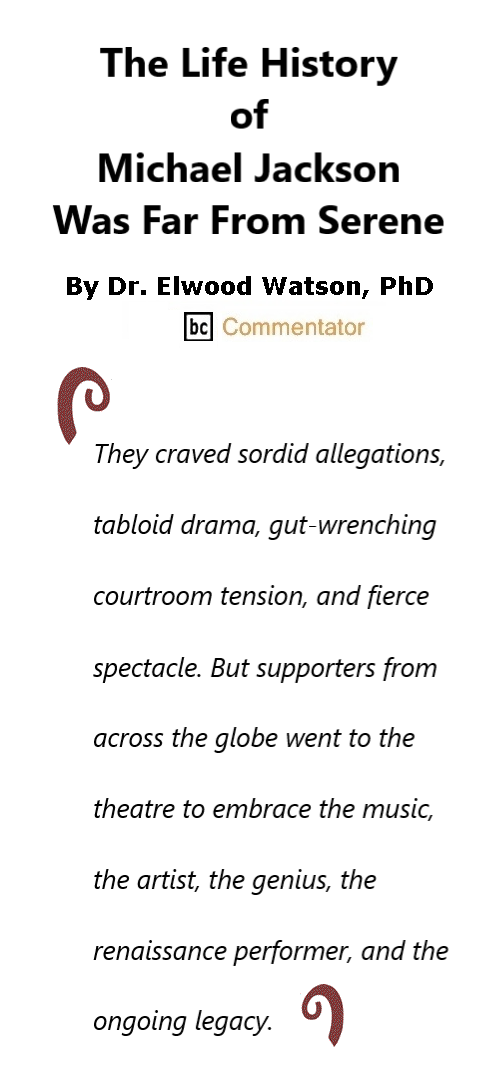
They hungered and longed for scandal. They
craved sordid allegations,
tabloid drama, gut-wrenching courtroom
tension, and fierce spectacle.
But supporters from across the globe went to
the theatre to embrace
the music, the artist, the genius, the
renaissance performer, and the
ongoing legacy, coupled with the reminder that
Michael Jackson
remains one of the most distinctive
celebrities in modern history.
Could
Michael Jackson have handled some of his
public relations better than
he did? Certainly. I do not think too many
people would argue about
this. To be sure, like a number of people,
Michael Jackson was
eccentric. However, being nonconformist is not
a crime, nor does it
mean that he was the reprobate that many of
his opponents made him
out to be. The reality is that notable degree
of criticism directed
toward Jackson was due to racial
hostility
and resentment.
Love him or hate him, there is no doubt that
Michael Jackson was one
of the most talented entertainers the world
has ever seen, and it
will be a long time, perhaps never, that we
may see his likes again.
As the Rev
Al Sharpton
commented
at his memorial service in 2009, “Thank you,
Michael.” I concur.
May he continue to rest in peace.
|
|