Many people have reacted to “the
recent roast of Kevin Hart” - and not exactly positively. The
raucous event publicly released on May 10
included acerbic jokes from comedians Shane
Gillis, Tony Hinchcliffe, and others.
Hinchcliffe made a joke about George
Floyd that generated considerable online
backlash. Pete Davidson and Hinchcliffe both
made jokes alluding to but not overtly saying
the N-word. Numerous comedians, among them
Dwayne Johnson, Gillis, and Jeff Ross,
repeatedly joked about Hart’s late father’s
drug addiction. Ross summarized the event’s
philosophy the next day with a phrase that
unintentionally captured the drama: “Nothing
was off limits.”
Not
surprisingly, the backlash was powerful and
swift with criticism coming from activist Tamika
Mallory, comedians Loni Love and Lil
Rel Howery, and even George
Floyd’s family who expressed their outrage
after Hinchcliffe, who previously made an insensitive
joke about Floyd, commented, “The Black
community is so proud of you . . . right now,
George Floyd is looking up at us all laughing
so hard he can’t breathe.” In response to the
callous remark, the Gianna and George Floyd
Foundation said the joke was “sad for the
culture.” Eventually, Saturday Night Live star Michael
Che weighed in. Taking issue with the
event’s writers, he stated, “White guys and
Black people joke different. Black guys roast
like, ‘look at this [N-word] shoes!’ White
roasts are like, ‘slavery, math, slain teens,
sex crimes, slurs, family secrets, etc.’” As
you can imagine, large segments of the
blogosphere went into overdrive with rabid and
ample criticism.
The question
is not whether celebrities or political roasts
should have boundaries. Rather, it is whether
adhering to the doctrine of “nothing is off
limits” demands a level of understanding
between the comedian and the audience about
who is espousing such rhetoric and the reasons
for doing so. When tragic and horrifying
situations such as George Floyd’s lynching
become the highlight of discussion during the
honoring of a Black celebrity, the question of
who is espousing such comments - and whether
they have secured the cultural legitimacy to
verbalize them in such an environment - cannot
be discounted. Additionally, both the N-word
and the subject of lynching have a deep, dark,
and sordid history in America, particularly
relating to Black Americans. Neither should be
perversely manipulated or ridiculed!
That said, a
number of people across racial lines,
including Blacks, have weaponized the term for
varied gain. Those of us old enough can
remember the Anita Hill–Clarence Thomas saga
in fall 1991. The hearings were a dramatic and
riveting spectacle filled with sleazy
revelations and intense commentary from all
sides. President George H. W. Bush nominated
Thomas in summer 1991 to replace Supreme Court
giant Thurgood Marshall who had the
distinction of being the first Black American
to serve on the court. Supporters of Hill and
Thomas delivered eloquent and often
heart-wrenching testimony about their own
lives as well as those of Hill and Thomas.
The most
notable and stunning (depending on your point
of view) comment emanating from the event was
Thomas’s declaration to the Senate Judiciary
Committee that he was “the victim of a high-tech lynching
for uppity Blacks who deign to think
for themselves.” Yes indeed! With a straight
face, the now Justice Thomas brazenly espoused
such a disingenuous remark! For those of us
who were already glued to our television sets,
such an unabashedly arrogant comment was the
height of intellectual dishonesty.
Several Black
(and some White) public figures cried “How
dare he!” and took to the op-ed pages of
prestigious newspapers and magazines to
criticize Thomas. To be sure, others offered
supportive commentary. The Senate eventually
confirmed Thomas 52–48, the closest margin of
victory ever for a Supreme Court nominee. To
me and other people of color, in particular
Black Americans, the most outrageous moment of
this saga was Thomas’s audacity in comparing
his situation to a lynching! He undoubtedly
caught the Judiciary Committee off guard too.
Say what you will, I have to concede that
Thomas demonstrated perverted cleverness and
genius.
I am certain
that he ruminated about which word would have
the most powerful and resonating impact on the
Judiciary Committee. Although a dishonest and
insulting tactic, it successfully elevated him
to the highest court in the US. While I abhor
his stunt, Thomas must have known that it
would work in his favor.
Other
high-profile Black men have followed Thomas’s
lead. They include disgraced mega entertainer
and convicted felon Bill Cosby, the late
Virginia lieutenant governor Justin Fairfax,
and currently incarcerated R&B music
superstar Robert Kelly (aka R. Kelly). They
all claimed that they were the victims of
lynchings! Please! To add insult to injury,
Cosby compared himself to freedom-fighting
statesmen Nelson Mandela and Mahatma Gandhi.
No need to respond to such bulls*it! While
Cosby, Fairfax, and Kelly found themselves
under siege (largely due to their own
misbehavior and missteps), they were never the
victims of lynchings! In fact, when I first
read about their claim to be lynching victims,
my reaction was “Negroes, please!” I am not
allowed to print what I actually said!
To my
knowledge, none of them had a noose tied
around their neck or were brutally drowned in
a river with a rope or other materials
strapped to their bodies. None was strung up
from a large oak tree. None had their hands,
feet, or genitals cut off (in some cases
stuffed in their mouth), gasping their last
dying breaths as crowds of White men, women,
and even young children gawked with
animalistic glee, hurling racial epithets and
other ribald comments as the bodies limply
swung back and forth from a tree. For added
“entertainment,” the killers could have doused
the victims with gasoline, set them on fire,
and allowed them to burn to ashes. Afterward,
vile and crazed spectators would frantically
pick at the seared corpses to collect severed
body parts as souvenirs or for other
unthinkable purposes. Let’s cut to the chase.
Yes, we know that Black American men have had
a long and tortured history of being the
frequent victims of a vehemently hostile and
racially biased criminal justice system that
has routinely scapegoated and targeted Black
and increasingly Brown men.
Some Black
men in history were indeed lynched. For
example, Emmett Till and George Stinney Jr.,
both teenage Black boys in mid-20th century
America. Many Black men and some women were
taken from their homes in the middle of the
night or sometimes in broad daylight and were
lynched! Black families in the south and other
parts of the nation, their homes firebombed in
the middle of the night while they slept,
unable to escape the flames and burned to
death, were lynched. Lynching has affected
countless numbers of Black families. The
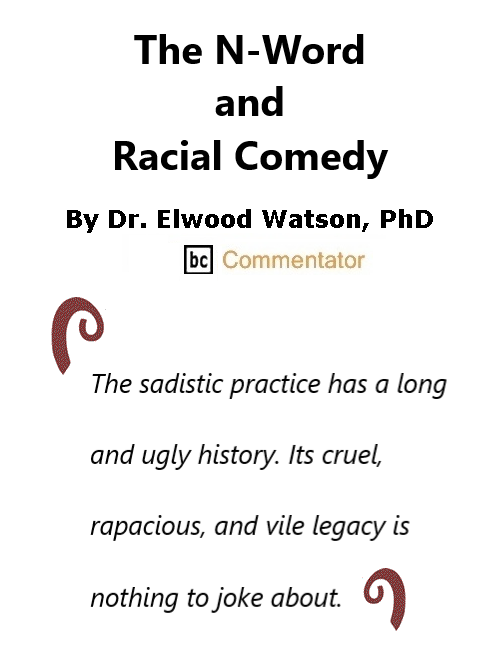
sadistic practice has a long and ugly history.
Its cruel, rapacious, and vile legacy is
nothing to joke about. Indeed, it is an
affront to the thousands who endured such an
abominable experience.
|
|