|
Imagine
having electricity for only four hours a day.
Now imagine
not knowing which four hours.
Can you make
coffee? Refrigerate medicine? Charge your
phone? Will your child have school? Will the
bus come? Will the internet work? Will your
food spoil?
For the
remaining twenty hours, you wait.
Americans are
so dependent on electricity that the thought
itself feels jarring.
Unless you
live in Cuba.
I recently
returned from Cuba as part of an all-African
American delegation organized by the Institute
of the Black World and led by Dr. Ron Daniels.
We traveled to learn, to listen, and to better
understand a nation Americans are often
encouraged to view through slogans rather than
lived experience.
Our
experience was not the experience of most
Cubans. We stayed in a hotel that generally
had electricity. We experienced only brief
outages in restaurants and public spaces. But
everywhere we went, people described blackouts
lasting as long as twenty hours a day -
planned outages, unplanned outages,
neighborhoods going dark without warning,
daily life organized around uncertainty.
Imagine
trying to run a school, a hospital, a
restaurant, or simply a family under those
conditions.
And still
people move forward.
One woman
traveled nearly three hours to meet a member
of our delegation. Part of her journey
involved walking. Part involved hitchhiking.
Three hours.
She simply
wanted to spend time with her friend.
We shared
lunch together at a paladar, one of Cuba’s
small private restaurants. She was thirty-one
years old, attractive, warm, and funny.
I asked
whether she had children.
She shook her
head.
“How
can
I afford it?” she replied.
She was once
a teacher. Now she picks up part-time work.
She cannot
afford to have children.
That answer
has stayed with me.
Because this
crisis is not only affecting the present.
It is shaping
the future.
I also spoke
with a ten-year-old boy.
I asked when
he attended school.
He shrugged.
“Tuesday
and
Wednesday.”
That was his
answer.
Not Monday
through Friday.
Tuesday and
Wednesday.
What
opportunities disappear when school becomes
irregular? What happens when uncertainty
becomes normal for children?
Race hovered
over many of our conversations. Cuba’s laws
prohibit racial discrimination, and senior
leaders we met with - including the President
and parliamentary leadership - acknowledged
that racism persists. Yet when our delegation
asked direct questions about race, we often
received answers that felt cautious and
rehearsed.
As an
economist, I know laws matter.
I also know
laws rarely eliminate inequality by
themselves.
At Cuba’s
medical school, one of our colleagues asked
doctors about mental health.
Who takes
care of the caregivers?
One
physician, who had seemed eager to speak,
suddenly broke down in tears.
That moment
stunned me.
These are
people trained to care for others while living
amid shortages, uncertainty, and extraordinary
pressure.
And yet.
Wherever we
went, people offered coffee.
Or water.
Or
hospitality.
Again and
again.
Despite
shortages.
Despite
hardship.
Despite not
having enough.
The debates
about Cuba are loud and ideological. Some
blame socialism. Others blame the blockade and
decades of economic isolation. Most
acknowledge that today’s crisis emerged from
multiple forces colliding at once.
I know
economists prefer macro explanations.
But I keep
returning to micro realities.
A woman who
cannot imagine motherhood.
A child with
only two days of school.
A doctor who
breaks down in tears.
People with
almost nothing still offering coffee.
People debate
Cuba endlessly.
So do I.
But after
returning home, I find myself thinking about
something simpler.
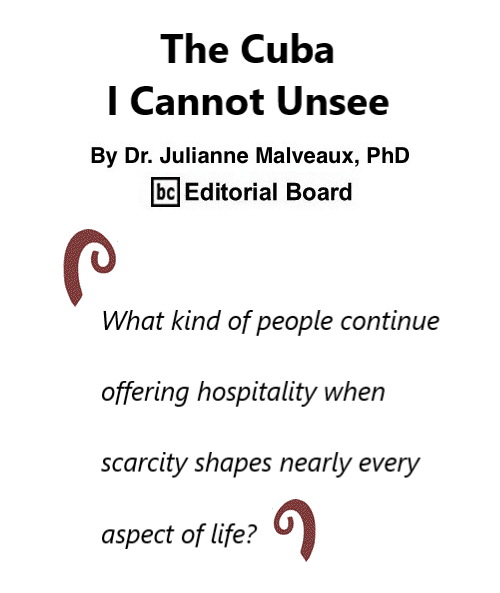
What kind of
people continue offering hospitality when
scarcity shapes nearly every aspect of life?
That is the
Cuba I met.
Not the
slogans.
Not the
talking points.
Not the
abstractions.
The people.
And that is
the Cuba I cannot unsee.
|