Consumers
love
a sale. We love the little red
tag, the “limited time only,”
the breathless “50% OFF!” that
promises we’re getting over on
somebody. At this time of year,
the sales signs practically scream
at
us, and we rush to stores
convinced we’ve won a battle
against high
prices. But here’s the truth
retailers hope you never pause
long
enough to consider: if
a store can slash a price by
half and still make money, were
you ever
getting a real deal?
That’s
the mystery of the markdown. And
once you pull back the curtain,
the
mystery dissolves into a simple
equation: the
retailer is not losing money -
far from it.
Let’s
start with the math. Most
consumers imagine that when they
buy a $100
sweater, somewhere in Bangladesh a
worker made it for $60 or $70, and
the retailer added a modest
markup. Not! That $100 item cost
the
retailer between
$20
40,
or even less if it’s fast fashion.
What
happens when the store announces
“50% off”? That $100 sweater
becomes $50 at the register.
Sounds like a steal, right? But if
the
retailer paid $30 for it, they’re
still pocketing $20 in profit.
That’s a 40%
margin,
even after the dramatic price
“cut”. No pain. No loss. Just
business.
The
“deal” is not on the clothes. The “deal” is
on your behavior.
Retailers
understand psychology even better than
economics. They know the
dopamine hit of thinking we beat the system.
They know the urgency of
a ticking clock. They know we walk in for
“one thing” and walk
out with a cart. Savings is the bait; profit
is the switch.
We’ve
all nipped at the bait. I’ve driven dozens
of miles to a mall for a
sale. I’ve stood in line for a half-off of
designer clothing. I’ve
bought junque that I did not need because it
was “on sale”. That
was a lifetime ago. These days I shop in my
overflowing closet. I
tell myself I will never need a new item of
clothing again. Kind of.
I can’t tell you when I last bought “new
stuff”. But I confess
that when faced with the possibility of a
high visibility event, I
called my favorite “Black girl” store
(Katula in LA) to ask them
to send me pics of something fabulous.
Regaining good sense, I called
hours later to say, “never mind”, I got
this.
Bait
and switch. Even the so-called “regular
price” is a fiction. In
many states, a retailer can raise a price
for a few weeks, then
proclaim a markdown that feels massive but
is meaningless. Those
“compare at $149!” stickers? Often invented
numbers. Those
“before and after” tags? Carefully
engineered illusions.
The
real misery behind the markdown isn’t felt
by the retailer or the
bargain-seeker. It’s borne by the workers
whose low wages make the
whole system possible. By the warehouse
crews who don’t see their
families during the holidays. By the
delivery drivers forced into
sixteen-hour shifts. By the sales associates
who smile through
exhaustion for $15 an hour - if that.
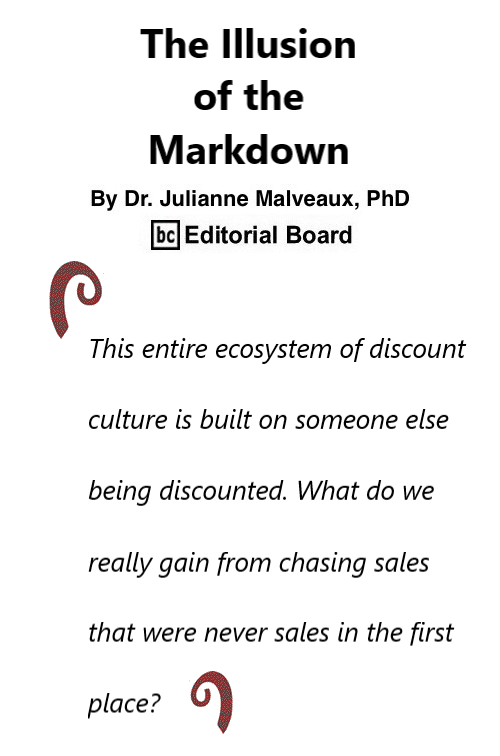
This
entire ecosystem of discount culture is
built on someone else being
discounted.
Retailers
have
gotten more sophisticated, not less. Today’s
“sales” are
algorithmically timed, psychologically
targeted, and strategically
priced. Businesses know exactly how much
inventory they can move at
each price point, and they build markdowns
into their annual plan.
The sale is not a surprise – it’s an
important tactic in the
strategy to increase profits.
A
retailer might lose money on one
“doorbuster” TV, but that’s a
deliberate sacrifice to lure you into a
store filled with 200%
markups. You came for the deal; you stay for
the illusion. And you
leave thinking you’ve triumphed, not
realizing you’ve played the
part retailers wrote for you.
So
as the holiday season barrels
toward us, and as communities -
especially Black communities - are
bombarded with pressure to buy,
buy, buy, it’s worth asking: what
do we really gain from chasing
sales that were never sales in
the
first place?
For
many of us, the cost isn’t just financial;
it’s emotional. We
feel guilty when we don’t spend. We feel
inadequate when we can’t
gift lavishly. And too often, we sacrifice
long-term financial
well-being for short-term “joy” engineered
by an industry built
on extraction. It’s called predatory
capitalism.
The
markdown is not serving you or your family,
not serving the workers
whose bodies absorb the true cost of
America’s bargain culture.
The
retailer isn’t slashing their profits.
They’re slashing your
perception.
Why
do we keep celebrating the privilege of
being played?
This
year, let’s refuse the hustle. Let’s stop
applauding fake
generosity.
Let’s
protect our wallets, our dignity, and our
sanity.
The
markdown
isn’t a gift. It’s
a
business model.
It only works if we keep falling
for it.