This year, Black History Month marks its
100th anniversary. At this pivotal moment - on
the eve of America’s 250th anniversary - Black
History Month stands as a necessary corrective
to the nation’s revisionist history, selective
memory, and deliberate attempts at erasure.
This year, no Black
History Month programs are scheduled at
Trump’s Kennedy Center. In 2025, as part of
Donald Trump’s renewed campaign to dismantle
Diversity, Equity, and Inclusion (DEI)
initiatives across Washington, D.C. federal
buildings, the Department of Defense
“mistakenly removed” a webpage honoring Jackie
Robinson’s service in the U.S. Army. The
public outcry was swift. In 2023, to kick off
Black History Month, Florida Governor DeSantis
rolled out his list of banned books by Black
authors - including the works by Harvard
professor and PBS Finding Your Roots host Henry
Louis Gates Jr.
From its inception, Black History has
been the subject of criticism.
Dr. Carter G. Woodson - the Father of
Black History - established Negro History Week
in 1926, deliberately choosing February to
coincide with the birthdays of Abraham Lincoln
and Frederick Douglass. His aim was to ensure
that Black achievements, struggles, and
contributions would not be omitted from the
American story.
A century later, the resistance to Black
History Month only underscores its necessity.
Trump needs a Black
History tutorial
Frederick Douglass is dead. In 2017,
President Donald J. Trump didn’t appear to
know this fact. Disturbingly, in 2026, he
still may not. When Trump kicked off Black
History Month in 2017, he hosted a so-called
“listening session” at the White House that
left attendees scratching their heads. His
remarks about Frederick Douglass - a
self-liberated, formerly enslaved man turned
towering abolitionist - died in 1895. Trump
believed Douglass was somehow still alive and
actively producing new accomplishments.
Reporters looked to then White House
Press Secretary Sean Spicer to clarify what
Trump meant. Instead, Spicer only deepened the
confusion, making it clear he, too, was
uncertain whether Douglass was dead.
“I think he [Trump]
wants to highlight the contributions he has
made,” Spicer said. “And I think through a lot
of the actions and statements he’s going to
make, I think that the contributions of
Frederick Douglass will become more and more.”
The remarks from both Trump and Spicer
could have been an episode of “Drunk History,”
a TV comedy series where an inebriated
narrator fumbles to recount historical events,
which illustrates why we need Black History
Month and an intensive tutorial for Trump and
his administration then and now.
The Civil War
continues...
In 2017, Trump’s White House Chief of
Staff, John Kelly, depicted Confederate
General Robert E. Lee as “an honorable man”
and asserted that “the lack of an ability to
compromise led to the Civil War.” Those
remarks only deepened the nation’s divide and
misunderstanding over slavery and its legacy.
That Kelly - Boston-born, no less - made these
comments on Laura Ingraham’s Fox News show was
perhaps unsurprising.
Kelly’s framing reflects a troubling
moral relativism, one that suggests there is
no absolute truth about the Civil War - only
competing narratives shaped by individual or
cultural perspective. In doing so, it
minimizes the central role of slavery and
blurs the moral clarity history demands.
Why does this history
matter?
Had John Kelly been better versed in
Civil War history, he would know that when the
war ended, Robert E. Lee refused to be buried
in his Confederate uniform. He also urged his
followers to put away their flags, warning
that their continued display as acts of
defiance would amount to treason. Lee
understood that reconciliation required an end
to Confederate symbolism - not its
preservation.
Moreover, Lee’s great-great-grandson,
Robert E. Lee V, echoed this sentiment. In the
summer following the violent unrest in
Charlottesville over the planned removal of
Lee’s statue, he addressed the proliferation
of Confederate symbols across the South:
“First and foremost,
if it can avoid any days like this past
Saturday in Charlottesville, then take them
down today. That’s not what our family is at
all interested in, and that’s not what we
think General Lee would want whatsoever.”
White Americans - like Kelly - must learn
the full and accurate history of the Civil
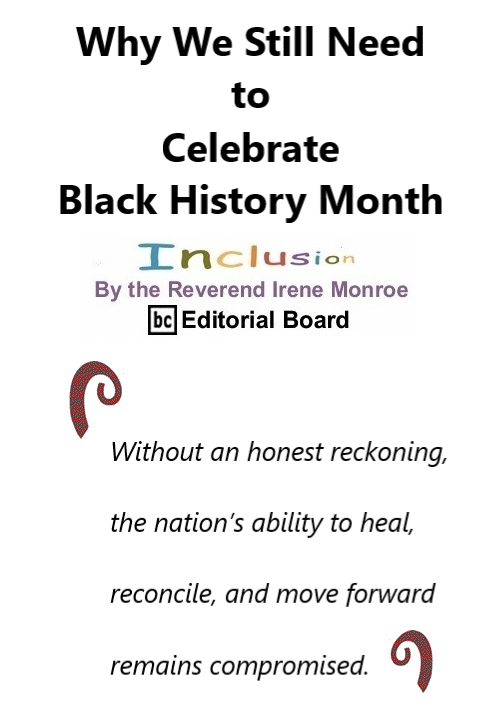
War. Without an honest reckoning, the nation’s
ability to heal, reconcile, and move forward
remains compromised.
Post-racial myth
With the election of Barack Obama as
president, queries arose about whether Black
History Month was still necessary. Some
Millennials, in particular, whose ballots
helped elect the country’s first
African-American president, revealed that
celebrating Black History Month seemed
outdated. To them, the continuation of Black
History Month was a relic tethered to an old
defunct paradigm of the 1960s Black Civil
Rights era and hindered the country’s
progress.
That sentiment was echoed in 2009 by
Republican Senator Mitch McConnell. McConnell
gave his reasons: the 13th Amendment abolished
slavery, the 1965 Voting Rights Act
enfranchised Black Americans, and the election
of Barack Obama.
Obama’s candidacy,
for many, was seen as having cleansed America
of its Original Sin and ushered in a
long-awaited “post-racial” era - in which race
had finally become a “non-issue.” In an effort
to underscore just how “post-racial” Obama
supposedly was, Michael Crowley wrote in The New Republic in his 2008
article “Post-Racial” that it was not only
liberals who were unbothered by Obama’s race,
but conservatives as well - even the notorious
former Klansman David Duke. “Even white
supremacists don’t hate Obama,” Crowley wrote,
noting Duke’s apparent nonchalance: “[Duke]
seems almost indifferent about Obama, don’t
see much difference between Barack Obama and
Hillary Clinton - or, for that matter, John
McCain.”
For some white
Americans, Obama’s election became both a
physical and symbolic fulfillment of Martin
Luther King Jr.’s vision, articulated in his
historic “I Have a Dream” speech at the 1963
March on Washington. Yet for Black Americans,
the decades since the March have revealed the
deliberate political misuse of King’s words -
particularly his line about children being
judged “not by the color of their skin but by
the content of their character.” That single
sentence has been weaponized to discredit
race-conscious remedies for historical
injustice, including affirmative action (which
the Supreme Court allowed to erode beginning
with Bakke under the guise
of “reverse discrimination”), reparations,
Critical Race Theory, African American
history, and now Diversity, Equity, and
Inclusion (DEI) initiatives. In 2023, the
Supreme Court formally ended affirmative
action in college admissions with Students for Fair
Admissions v. President and Fellows of
Harvard College. Against this
backdrop, Trump 2.0’s cancellation of Black
History Month came as no surprise. He
eliminated all so-called “identity months.”
For decades, the celebration of Black
History Month - especially among white
conservatives - has provoked ire framed around
“identity politics” and “special rights.”
Senator John McCain once argued that “special
rights” were precisely why he opposed the
creation of the Martin Luther King Jr. holiday
and refused to acknowledge it - until,
notably, he ran against Barack Obama for the
presidency in 2008.
Still, we rise
The backlash against
Black History Month is not new. It is now a
century old - and deeply rooted in the
persistent refusal to confront America’s
racial history honestly. The creation of Black
History Month was never intended by Woodson to
be divisive but rather to educate all
Americans of African Americans’ contributions
in a shared, though complex, history. With 250
years of slavery followed by 90 years of Jim
Crow and then 60 years of “separate but equal”
discriminatory practices, those hidden voices
and stories have shaped not only our
communities but, in turn, this nation. Black History Month
stands not as a footnote to American History
but rather reminds us that a nation cannot be
whole unless it remembers itself fully -
uncensored, unredacted and unerased.