Yep,
here we go again, America, gathering around
the national campfire to
argue about race like it’s a family reunion
where nobody actually
likes each other but everybody insists on
staying for dessert. And
somewhere in the middle of this ongoing
social group project gone
wrong sits a simple, uncomfortable idea:
maybe the problem isn’t
that America needs to “Make America Great
Again.” Maybe, just
maybe, it needs to make white America better
than it has historically
chosen to be.
Yes,
I said better. Not richer. Not louder. Not
more nostalgic for an
imaginary 1957 where gas was cheap, unions
were strong, and certain
people conveniently knew their “place.”
Better as in wiser.
Better as in more honest. Better as in
capable of looking at history
without breaking into defensive hives.
Now
before somebody clutches pearls hard enough
to start a diamond mine,
let’s establish something plainly. I don’t
wake up every morning
plotting against white people. That sounds
exhausting, and frankly I
have bills and back pain like everyone else.
I live around white
folks. Work with white folks. Smile, joke,
exchange pleasantries
about weather and football scores with white
folks. Civilization
functions perfectly fine at the surface
level. America runs on polite
small talk and mutual avoidance.
But
then the conversation goes deeper. Race
comes up. History sneaks into
the room. Maybe music, policing, politics,
or why certain
neighborhoods look the way they do. Suddenly
it feels less like
dialogue and more like two people describing
entirely different
planets.
Because
for many Black Americans, history is lived
memory. For many white
Americans, history is an optional elective
they believe they already
passed.
With
white women, there is often more shared
ground. Empathy shows up more
frequently. The understanding of exclusion,
dismissal, and structural
barriers creates overlap. But even there,
election night after
election night reminds us of a stubborn
political gravity. A majority
still aligns with the same structures that
protect white male
dominance, even when those structures openly
undermine women
themselves. Solidarity, it turns out, has
limits when proximity to
power is on the ballot.
And
let’s be clear about something else.
Assholes are universal.
Humanity distributes them evenly across
race, religion, gender, and
geography like cosmic confetti. I’ve told my
kids and my students
that for decades. No group owns monopoly
rights on bad behavior.
But
patterns matter.
When
arrogance,
entitlement,
and a startling
lack of empathy
begin appearing not just in individuals but
as normalized cultural
traits, we have to stop pretending
coincidence is doing all the work.
If someone walks into ten rooms and smells
smoke every time,
eventually they stop blaming candles and
start looking for a fire.
Enter
Donald Trump, America’s walking personality
test.
Trump
didn’t invent racism. He didn’t manufacture
resentment. What he
did was remove the social muffler. He gave
permission.
Suddenly things once whispered became rally
chants. Cruelty
became
authenticity. Ignorance
became
courage. And millions of white Americans
didn’t recoil. They
embraced him, defended him, rationalized
him, and built an entire
political identity around grievance
disguised as all-American
patriotism.
That
wasn’t a glitch. That was a reveal.
And
here’s where the accusation machine kicks
in. Pointing this out,
apparently, makes you the racist. Observing
patterns equals hatred.
Noticing history equals division. Saying,
“This behavior is
harmful,” somehow becomes worse than the
behavior itself.
It’s
a fascinating trick. Reality becomes
offensive simply by being
described.
Consider
Barack Obama. Calm. Measured. Moderate to
the point that many
progressives spent eight years begging him
to show more fight. Yet
large portions of white America reacted as
if he had marched into
Washington carrying a revolutionary
manifesto and a torch. A man who
governed like a cautious law professor was
treated like Nat Turner
with nuclear codes.
That
reaction told us something profound. The
fear wasn’t about policy.
It was about symbolism. The mere presence of
competent Black
leadership unsettled a psychological
hierarchy many Americans insist
no longer exists while simultaneously
defending it with Olympic-level
enthusiasm.
So
when people claim critics “hate white
people,” what they often
mean is this: you refused to participate to
aide and abet in the
comforting fiction.
Awareness
feels like accusation to those invested in
innocence.
Here’s
the uncomfortable truth. The call isn’t to
make white people feel
guilty forever. Guilt is useless if it
doesn’t evolve into growth.
The real challenge is maturity. A serious
nation acknowledges harm,
learns from it, and chooses improvement over
denial.
Germany
teaches its children about Nazism without
pretending it was a
misunderstanding. South Africa held truth
commissions. Meanwhile,
America treats honest historical discussion
like a hostile takeover
of Thanksgiving dinner.
The
irony is painful. Many white Americans pride
themselves on
individualism, courage, and moral clarity,
and yet collective
introspection remains the one frontier they
refuse to explore. We
will colonize Mars before we collectively
admit real estate redlining
wasn’t
an accident.
Making
white America better doesn’t mean erasing
heritage or demonizing
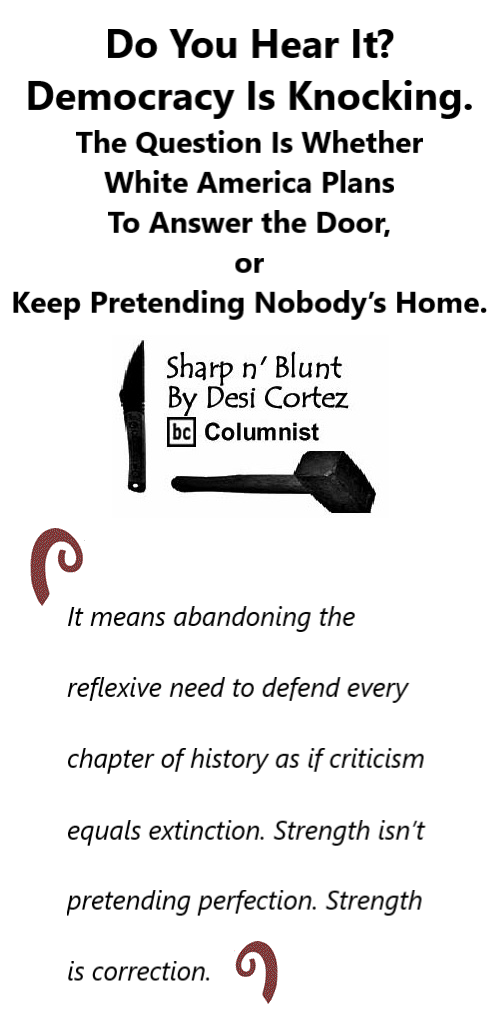
ancestry. It means abandoning the reflexive
need to defend every
chapter of history as if criticism equals
extinction. Strength isn’t
pretending perfection. Strength is
correction.
Imagine
the cultural power if white America led that
charge instead of
resisting it. Imagine rejecting politicians
who trade in fear.
Imagine refusing media ecosystems that
profit from racial panic.
Imagine choosing curiosity over
defensiveness when confronted with
lived experiences different from your own.
That
would be revolutionary. Not loud revolution.
Quiet moral evolution.
Because
here’s the secret nobody wants to say out
loud: America works best
when white Americans expand democracy rather
than restrict it. Every
major leap forward in this country required
multiracial coalitions
where enough white citizens decided fairness
mattered more than
hierarchy. Abolition. Labor rights. Civil
rights. Voting rights.
Progress happened when conscience outweighed
comfort.
The
tragedy of the MAGA era is not simply its
harsh cruelty. It is its
smallness. A movement fueled by nostalgia -
a deep, deep desire for
phony, fake, artificial societal dominance
instead of a noble
ambition for shared greatness. A
philosophical obsession with “who”
belongs rather than “what” we could build
together.
Maybe
greatness isn’t something to remember, but
something to finally
demonstrate. The real upgrade would be
trading heroic legends for
everyday decency. And there’s the real goal
and mission: not
greatness as folklore, but greatness as
behavior.
Great
enough to hear constructive criticism
without collapsing into spoiled
brat victimhood. Great enough to recognize
privilege without
interpreting it as insult. Great enough to
reject leaders who
weaponize their resentment for profit.
Because
the future of American democracy does not
hinge on convincing Black
or Brown citizens to believe harder in
equality. They already have.
The question is whether white America is
willing to outgrow the
comfort of historical advantage and step
fully into democratic
adulthood.
That
isn’t punishment. That’s liberation.
And
maybe, just maybe, when that happens,
conversations won’t feel like
forced exchanges between two different
worlds. They’ll feel like
what this country keeps claiming it wants to
be but rarely practices:
a shared
one.
The
real crossroads is whether advantage remains
a lifestyle or democracy
becomes a commitment. Sure, of course,
America keeps talking about
freedom, but the unanswered question
remains: is white America ready
to share it like civilized, enlightened
grown folks?