No one can deny that Jesse
Jackson, who died last week at the age of 84 was
a larger than life figure. Whether it was the
Rev. Dr. Martin Luther King Jr.’s gut-wrenching
assassination in 1968, Barack Obama’s initial
address as president-elect in November 2008, or
any other historic moment relating to Black
history over the past sixty-plus years, the Rev.
Jesse Jackson Sr. was a major force and
presence. The fact that the nation lost such a
profound, transformative, and consequential
leader this month - Black
History Month - at a juncture when Black
Americans’ contributions to this nation’s
history are continually being obscured and
threatened with eradication, only magnifies his
passing.
From the time that I was in
elementary school growing up in southern
Delaware to my coming-of-age years in the early
1980s and well into adulthood, I remember
watching and admiring Jackson’s formidable trio
of characteristics: moral fearlessness, immense
intellect, and ample empathy. His frequent
rhetorical language coupled with his deft,
catchy and occasional rhythmic and rhyming
commentary such as “down
with dope, up with hope, keep
hope alive” and “I
am somebody” coupled with his
definitive acknowledgment of the individual
trademark call-and-response acknowledgment
successfully managed to instill pride, and
self-esteem within millions of Black Americans
and other largely disenfranchised groups of
people.
He was a global humanitarian
whose voice for justice and equality echoed
across the world. His work across continents was
deeply etched in the impervious sense that civil
rights, economic rights, and human rights were
inseparably intertwined. Whether he was speaking
before heads of corporations or acting as a
mediator negotiating human rights issues,
Jackson fiercely employed his faith and moral
conviction as instruments of diplomacy, justice,
and freedom.
His landmark organizations
Operation PUSH and the Rainbow Coalition
successfully managed to create a movement that
united diverse factions, such as people
experiencing poverty, the working class, labor
unions, farmers, students, and religious
faith-based communities, throughout the US. His
“one inclusive tent” vision brought together
Americans from all walks of life under the
banner of justice and opportunity. His style and
message of leadership provided representation
for millions who had long been politically
exiled from the nation’s economic and political
circles of influence and expanded the democratic
process in a manner that continues to affect the
nation today.
Jesse Jackson’s 1984 and 1988
presidential campaigns were significant moments
in American political history. They transformed
the Democratic Party’s public face as well as
the structure of global politics. Both campaigns
introduced proportional representation into the
Democratic delegate system, an act that
dramatically transformed how presidential
nominees were chosen and who got the opportunity
to have a voice in that process. Devoid of such
revolutionary changes, it is highly unlikely
that we would have witnessed the historic
election of Barack Obama as the first Black
president of the United States in November,
2008.
But Jackson’s 1984 and 1988
campaigns did more than elevate presidential
politics; they transformed down ballot political
contests throughout the nation. His legendary
grassroots organizing brought fresh energy,
voter participation, and much-needed
infrastructure to campaigns for city councils,
county commissions, and state legislatures. Due
in large part to his efforts, hundreds of Black,
Latino, and progressive candidates were elected
at various levels of government, successfully
transforming local, state, and national politics
for future decades.
His trademark fearlessness was
tested in the international arena as well.
Throughout his ministry, Jackson led heroic
missions to rescue and secure the freedom of
American soldiers, civilians, and missionaries
held hostage by ruthless dictators and regimes
hostile to America. Occasionally, he worked in
tandem with the US State Department and related
government agencies; other times he acted as an
independent force, deftly guided by his own
inner instincts. Time after time, he returned
home to American shores with newly freed
captives, living testaments to the power of his
global charisma among many international
leaders. His influence extended to strengthening
the Congressional Black Caucus, bolstering its
influence and stability as a political force.
Jackson’s visionary commitment
to justice was not only political but was also
deeply rooted in common sense. He was among the
early national leaders to draw attention to
communities suffering from environmental
neglect, inadequate sanitary sewer systems, or
basic infrastructure. As he saw it, poverty,
pollution, and policy were moral failures, not
merely political ones. His relentless advocacy
for clean water, fair housing, and equitable
development was part of his larger Utopic vision
of justice that connected with all aspects of
human dignity.
Like many African Americans,
Jackson felt utterly betrayed by much of the
Democratic Party’s abandonment of socially
progressive issues, democratic socialist
economics, and capitulation to Reagan’s
unchecked far-right neocon policies, which
openly set out to undo the social and
legislative gains of the Civil Rights Movement.
With a bloc of two million new voters, however,
Jackson, who earned a reputation as Washington,
DC’s “shadow senator,” also knew that Black
communities held the margin of victory for
Democratic primaries in their hands. He knew
that that power could not be given away to White
Democratic candidates who often made an
about-face into center-right politics in their
general races.
By the latter 1980s, Jackson
embraced issues of economic populism to dispel
the notion that he was a candidate solely
serving the concerns of Black voters. His
efforts were successful in garnering the support
of the Alabama state legislature, whose
membership included former National Guardsmen
who stared him down as a protester, with a
speech railing against “Honda and Toyota, Suzuki
and Yamaha, Sony and Panasonic, being unloaded
at the docks and replacing Buick and Chrysler in
the American market.” It was during this period
that he managed to secure the votes of
Midwestern farmers with his knowledge of
agricultural economics. In 1988, the Democratic
Party’s power brokers watched with a degree of
disbelief as he won the state of Michigan and
made major inroads with Americans of all
political stripes.
During this era, he was adamant
about doubling the federal education budget,
endorsed an earlier version of what we now call
the Medicare for All Act, and proposed the
development of a national infrastructure bank,
tax hikes on the wealthy, and a freeze on
military industrial spending. He was highly
critical of the Reagan administration’s wars in
Central America and its close relationship with
then apartheid South Africa. He campaigned on
Native American reservations and reached out to
LGBTQIA+ voters. In his electrifying
speech at the 1984 Democratic
National Convention, Jackson
said that “our flag is red,
white, and blue, but our nation is a rainbow -
red, yellow, brown, black, and white - and we’re
all precious in God’s sight,” adding that “We
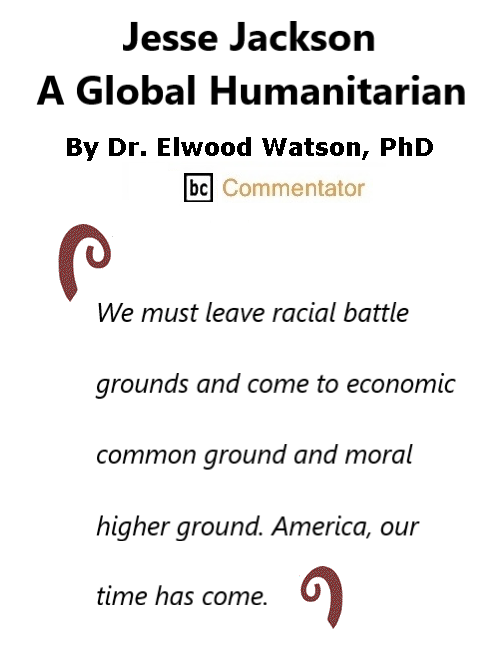
must leave racial battle grounds and come to
economic common ground and moral higher ground.
America, our time has come.” In the mid-1990s,
Jackson launched the Wall Street Project to prod
corporate America and Wall Street to open doors
to minority businesses and executives. A 1997
Wall
Street Journal article highlighted his success
in getting the New York Stock Exchange to
reverse a twelve-year policy of refusing to shut
down for Martin
Luther King Jr. Day. Indeed, Jesse Jackson was
tackling issues decades ago that leaders in both
major political parties are currently
addressing.
Like many people, of course,
Jackson had character traits that could rankle
others, and there were some who did not
appreciate his work. He had a testy relationship
with the Black Panthers due to his adamant
belief in reformist politics as opposed to
revolutionary tactics that the Panthers
preferred. He embraced an anti-abortion rights
stance after Roe v. Wade, which proved controversial for
many on the political left. Additionally, he was
a regular thorn in the White establishment’s
side, sometimes attracting the label of being
opportunistic or someone whose efforts resulted
in cronyism or corruption. Such charged
criticisms waned over time.
It was no secret that Jackson’s
unfettered ambition and drive impressed and
occasionally annoyed Dr. King, but they enraged
other civil rights leaders. His brazen antics
following King’s assassination in 1968 would
lead to a permanent split between him and King’s
family. Jackson, who was standing below the
balcony where King was shot, appeared on
television the next day wearing a shirt stained
with King’s blood. Other SCLC leaders were
appalled, and Coretta Scott King along with many
of the old guard Atlanta civil rights
establishment never forgave him. In a 2008
interview with CNN, Jackson defended his actions
in the wake of King’s death as those of a
traumatized young man: “If I made mistakes in
those hours, they were the mistakes of grief,
not ambition.”
During 1984, Jackson punctured a
hole in his presidential campaign when he made a
private antisemitic remark
to a Black Washington
Post reporter, which was later included in a
Post story. Though he
eventually apologized - and went on to finish
second behind Massachusetts Governor Mike
Dukakis in the 1988 Democratic presidential
nomination - in certain quarters his brash
comment was never forgotten or forgiven.
In 1999, Jackson fathered
a child with a woman other than his wife - he had an extramarital
affair with a Rainbow PUSH Coalition employee -
news that was released publicly in 2001. The
press duly covered the revelations, which led
CNN to cancel “Both Sides.” Jackson endured searing pain
when his son, Jesse Jackson Jr., a former
congressman, pled
guilty in 2013 to misspending $750,000 in
campaign funds for personal use and being
sentenced to thirty months in prison. In 2017,
he was diagnosed with Parkinson’s disease, a neurological disorder in
which mobility and speech decline over time.
To me, it was heartwarming to
see Jackson onstage at the 2024 Democratic
National Convention in Chicago, the city that
had been his signature home, paying homage to
the first-ever nomination of a Black woman by a
major party. He was wheelchair-bound, and his
disease by this point had confiscated the
greatest of his gifts - the ability to converse.
Nonetheless, his presence alone personified
dedication, determination, and legacy.
Jesse Jackson has now departed
this earth. He was a dynamic figure whose
courageous and unyielding efforts made life for
Generation Xers like me and fellow Black and
other non-White Americans (and many White women,
for that matter) a lot easier and helped us
attain greater success than we might ordinarily
have done. Thus, we are forever indebted to him.
Rest in peace, Jesse.
|
|