I
attended the memorial services this week
honoring Jesse Jackson,
joining thousands who gathered to celebrate
the life of a man whose
voice shaped the modern civil rights
movement. As speaker after
speaker reflected on Rev. Jackson’s
extraordinary life - his
preaching, his presidential campaigns, his
global advocacy for
justice - I found myself watching another
figure whose presence told
an equally important story about the
movement itself.
Jacqueline
Jackson sat quietly through much of the
program, dignified and
steady, the way she has been throughout
decades of public life
alongside her husband. Watching her, I was
reminded that the history
of the civil rights movement is often told
through the voices of its
most visible male leaders while the women
who sustained that work
remain less fully acknowledged. We remember
Martin Luther King Jr.,
Rev. Jackson, and other towering figures who
helped move this nation
toward justice, and rightly so. But
movements do not survive on
charismatic leadership alone. They endure
because women hold them
together.
Jacqueline
Jackson has lived that truth for decades.
Anyone who has spent time
in the civil rights community understands
that the work does not end
when speeches conclude or cameras turn away.
The movement is
sustained through meetings that stretch late
into the evening,
through endless travel, through community
gatherings and quiet
organizing, and through the emotional toll
of confronting injustice
day after day. Families live that life
alongside movement leaders,
sharing both its burdens and its purpose.
Yet Jacqueline Jackson has
never been merely a supportive spouse
standing quietly in the
background. She has participated in the
struggle in her own right,
traveling with delegations and bearing
witness to injustice not only
in the United States but across the broader
African diaspora.
Those
journeys often echo a much older story about
freedom struggles in the
Americas. Long before the modern civil
rights movement, enslaved
Africans who escaped bondage formed
independent communities
throughout the hemisphere, known as Maroon
societies. From the
mountains of Jamaica to the forests of
Brazil and the interior
regions of South America, these communities
created spaces of
autonomy and resistance that endured against
extraordinary odds.
Their history reminds us that the struggle
for dignity and
self-determination has always been
international. Back in the day,
during the 1984 campaign, Jackie often
talked about the Maroons.
Like
many women in the movement, Jacqueline
Jackson carried
responsibilities both public and private,
sustaining institutions
while nurturing family and community. Her
example is part of a much
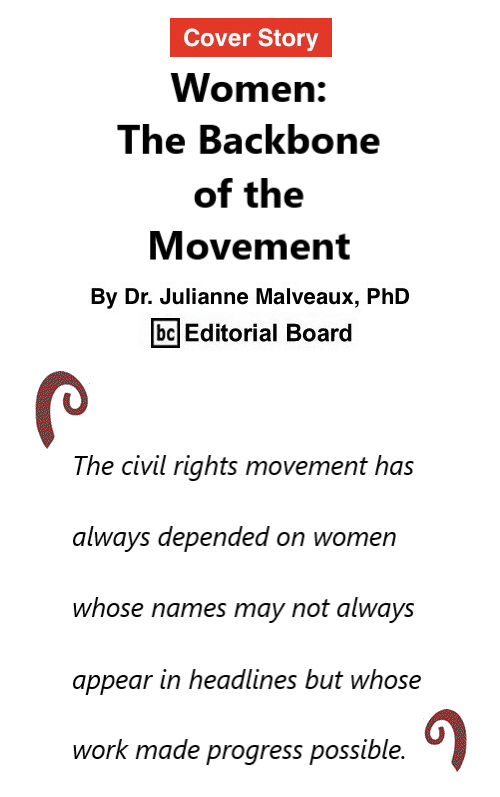
larger tradition. The civil rights movement
has always depended on
women whose names may not always appear in
headlines but whose work
made progress possible. Ella Baker shaped
grassroots organizing and
mentored generations of young activists.
Dorothy Height spent decades
advocating for civil rights and women’s
equality, building
coalitions and influencing policy, often
from behind the scenes.
Fannie Lou Hamer forced the nation to
confront the brutality of voter
suppression in Mississippi with a courage
that shook the conscience
of the country.
The
same quiet strength defined the life of
Myrlie Evers-Williams, who
had worked alongside her husband, the slain
civil rights leader
Medgar Evers. Long before the nation knew
her name, she was helping
manage the daily work of the movement -
answering phones,
coordinating schedules, supporting
organizing efforts, and helping
hold together the NAACP office in
Mississippi while Medgar confronted
some of the most dangerous forces in
American society. After his
assassination, she carried the work forward
with remarkable
determination, eventually serving as chair
of the NAACP.
These
women were not assistants to history; they
were architects of it.
They organized meetings, raised funds,
coordinated voter registration
drives, trained young activists, and held
communities together when
the struggle felt overwhelming. They
balanced public activism with
the responsibilities of family and community
life, often without the
recognition or authority that male leaders
automatically received.
As
the memorial services concluded, I was
struck by the generations
gathered to honor Rev. Jackson’s life.
Veterans of the civil rights
era sat alongside younger activists who are
now carrying the struggle
forward. Movements are never confined to a
single moment in history;
they are living traditions passed from one
generation to the next.
Through
it all, women remain the backbone of the
movement.