During
Women’s History Month I pay homage to all
women, but especially my
sistahs. When Maya Angelou wrote her famous
1978 poem “Still I
Rise,” she reminded us Black women that we
come from a long lineage
of movers and shakers - women who triumphed
not in spite of their
challenges, but because of them.
The
profound contributions of Black women to
American society were also
acknowledged by Barack Obama in his keynote
address at the
Congressional Black Caucus Foundation’s 45th
Annual Legislative
Conference in 2015. He told the audience
that “all of us are
beneficiaries of a long line of strong Black
women who helped carry
this country forward.” One of those
remarkable women - and I
personally knew -was my congresswoman,
Shirley Chisholm (D-NY), and
formed my activism.
“Unbossed
and Unbought”
Shirley
Chisholm represented my Brooklyn
congressional district for seven
terms, from 1969 to 1983. In our
neighborhood, we kids affectionately
called her Miss C. Al Sharpton - whom I grew
up with - served as
director of the youth division of her
campaign, and I was proud to be
part of it.
As
Brooklyn’s native daughter, Chisholm
understood our plight. She was
a grassroots insider whose multiracial
coalition and multilingual
approach resonated deeply in the
Bedford-Stuyvesant neighborhood,
which at that time comprised mostly of
disenfranchised
African
American and Puerto Rican residents.
Chisholm connected with everyday
people and the bread-and-butter issues
that shaped our lives -
childcare, education, unemployment,
housing, food security, and
opposition to the Vietnam War. She
addressed these concerns in both
English and Spanish while visiting our
housing projects, churches,
parks, and street corners - shaking hands
and listening carefully to
residents.
As
the people’s candidate, she branded
herself “Fighting
Shirley Chisholm.” Throughout the
neighborhood - and in the halls
of power in New York City - she was known
as a force to be reckoned
with: “unbought and unbossed.”
Her
campaign slogan, and motto “Unbought and
Unbossed,” - also the
title of her 1970 memoir - captured her
fierce independence and
integrity. With it, Chisholm presented
herself as a bold alternative
to a corrupt and moneyed political
establishment.
“Backbone”
of DNC
Black
women voters are lauded as “the backbone” of
the Democratic
National Committee. Shirley Chisholm was
instrumental in bringing
Black women into the DNC, national politics
and getting us to the
polls. Chisholm co-founded the National
Women’s Political Caucus in
1971, and the National Political Congress of
Black Women in 1984 with
Dr. C. DeLores Tucker.
As
a voting bloc, Black women have long
exercised agency and developed
powerful voter-mobilization strategies to
support our candidates. Our
strong voter turnout is rooted in a long
history of confronting voter
suppression - barriers that the Nineteenth
Amendment, which granted
white women the right to vote in 1920, did
not protect us from. Even
after the passage of the Voting Rights Act
of 1965, tactics designed
to suppress minority voting persist to this
day.
Black
women are a powerful voting bloc in both
local and national races.
Our representation in leadership roles must
be supported with funding
and resources from the DNC - support that
Shirley Chisholm herself
struggled to secure during her campaigns.
Chisholm
insisted that our voices must be essential
in political debates and
in shaping government policy. We are issue
voters, and we vote for
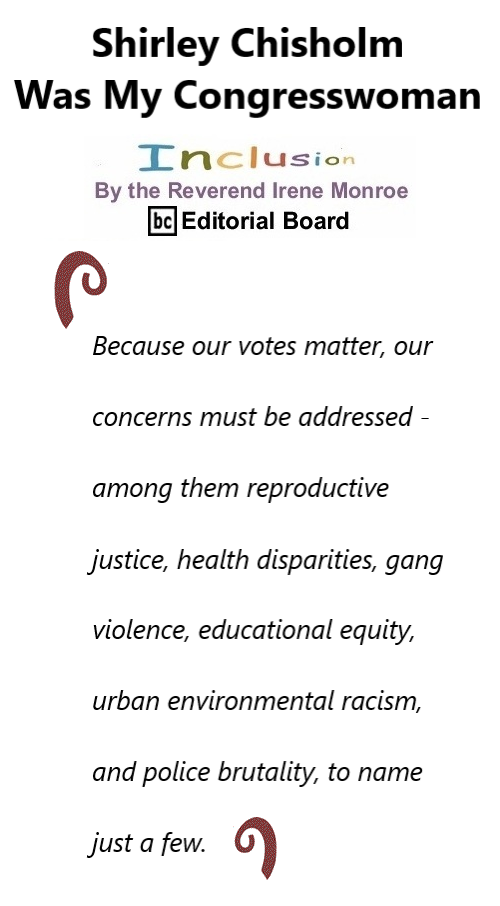
the world we hope to see. Because our votes
matter, our concerns must
be addressed - among them reproductive
justice, health disparities,
gang violence, educational equity, urban
environmental racism, and
police brutality, to name just a few.
The
Politics of Being the First
Chisholm
inspired generations of Black women in
politics, including Kamala
Harris.
When
I heard the news that Vice President Kamala
Harris was running for
president, I immediately thought about how
Chisholm would be proud of
this moment. Within hours of the
announcement hitting the newswires,
enthusiasm surged. A national Zoom call
organized by the Washington,
D.C.–based Black women’s organization
#WinWithBlackWomen drew
more than 40,000 sistahs. In just three
hours, these women raised
over $1 million to support Harris.
In
1972, Shirley Chisholm became the first
woman and the first person of
color to seek the presidency on the
Democratic ticket. Confronted
with fierce racist and sexist opposition,
she ultimately lost the
nomination. In 2024, Kamala Harris did as
well, yet Harris ran a
superb 107-day campaign that injected hope
and excitement about what
might be possible. It is the way Black women
have always moved
through history - “making a way out of no
way.” And it was
Chisholm who paved the path for those who
followed.
In
her 1973 book “The Good Fight,” Chisholm
explained why she ran
for president. She wrote:
“The
next time a woman runs, or a Black, or a
Jew, or anyone from a group
that the country is ‘not ready’ to elect to
its highest office, I
believe that he or she will be taken
seriously from the start… I
ran because somebody had to do it first.”
And
those “next times” came. In 1984, Queens
Representative Geraldine
Ferraro became the first woman nominated for
vice president by a
major party. In 1984 and 1988, Jesse Jackson
ran for president. In
2008, both Hillary Clinton and Barack Obama
sought the Democratic
nomination. In 2016, Clinton ran again. And
in 2024, Kamala Harris
carried the torch forward.
Today,
Representative Ayanna Pressley - who
represents my district -
occupies Shirley Chisholm’s old office in
Washington, D.C. Pressley
is the first Black woman elected to Congress
from Massachusetts,
another milestone in the long arc of
representation.
Black
women have helped change America even as the
nation remains mired in
its Original Sin and the enduring legacy of
injustice. Time and
again, Black women have stood at the
forefront of social change -
leading coalition building, organizing
communities, and modeling
intersectional activism.
From
Shirley Chisholm, I learned that democracy
cannot remain an abstract
ideal proclaimed in campaign slogans. It
must be grounded in the
bread-and-butter issues of the day that
connect us to the promise of
the American dream - life, liberty, and the
pursuit of happiness.
Democracy
begins to work only when those relegated to
the margins of society -
people Chisholm tirelessly fought for - can
begin to experience the
rights and opportunities that others take
for granted as inalienable.
Chisholm taught me that the path toward that
democracy begins at the
ballot box.