Washington
is
talking about spending $200
billion on war. That number rolls off
the tongue easily in Washington, where
policymakers casually toss around figures
- millions, billions, trillions. But
numbers that large lose their meaning
unless we slow down long enough to put
them into context.
Two
hundred billion dollars - that’s 200,000
million. What could we do with 200,000
million dollars?
That
amount of money could transform the student
debt
crisis in this country. It could
provide real relief to millions of
borrowers who are struggling to keep their
heads above water while paying loans that
often feel impossible to escape.
There is
about $1.7 trillion in student loan
debt in the United States today. More
than 40 million people carry
that burden. For many of them, student
loans are not simply a monthly payment.
They are a barrier to buying a home,
starting a business, saving for
retirement, or even beginning a family.
For Black
borrowers, the situation is even more
severe. Because of the racial wealth gap,
Black students borrow more to attend
college. Because discrimination persists
in the labor market, they often earn less
after graduation. And because of those two
realities, their loans linger longer.
Research shows that four
years after graduation, the typical
Black borrower often owes more than they
originally borrowed, while
white borrowers have usually begun to
reduce their balances.
Student debt has quietly become
another engine driving the racial wealth gap
wider. It doesn’t just burden individuals -
it deepens the very gap policymakers claim
they want to close. When education requires
debt and wealth determines who can borrow
safely, the system quietly reproduces the
inequality it claims to solve.
Yet when the subject turns to
student debt relief, Washington suddenly
becomes cautious. We hear lectures about
fiscal responsibility, warnings about moral
hazard, and endless debates about whether
relief would somehow be unfair. But fairness
rarely enters the conversation when the
subject is military spending.
When war funding is on the table,
Congress can move quickly. When it comes to
helping ordinary people - especially young
people trying to build a future - the
urgency disappears.
Student debt is not only a personal
burden; it is also an economic issue. When
millions of people are saddled with debt,
they spend less, delay buying homes,
postpone entrepreneurship, and make career
choices based on loan payments instead of
passion or talent. In other words, student
debt acts like a brake on economic dynamism.
We often
hear politicians say that budgets reflect
priorities. They are right. Show
me your budget and I will tell you your
values.
Right now, the values reflected in
federal spending are unmistakable. Billions
can be mobilized quickly for war. Trillions
have been allocated over the years for tax
cuts and corporate subsidies. But when it
comes to relieving the financial burden
carried by millions of students -
disproportionately Black students - the
conversation suddenly becomes complicated.
Let’s go
back to that number: two
hundred billion dollars - 200,000
million.
What could we do with that kind of
money if we truly cared about opportunity?
Student debt is only one place we
could invest those resources. The
possibilities go far beyond loan relief.
We could build hundreds of
thousands of affordable homes. We could
repair schools where children are still
learning under leaking roofs and broken
heating systems. We could strengthen
hospitals and community health centers that
serve the people who need them most. We
could rebuild roads, bridges, and transit
systems that are literally crumbling beneath
us. And we could create millions of good
jobs doing that work.
We could dramatically reduce
student debt. We could expand access to
education. We could narrow the racial wealth
gap instead of widening it.
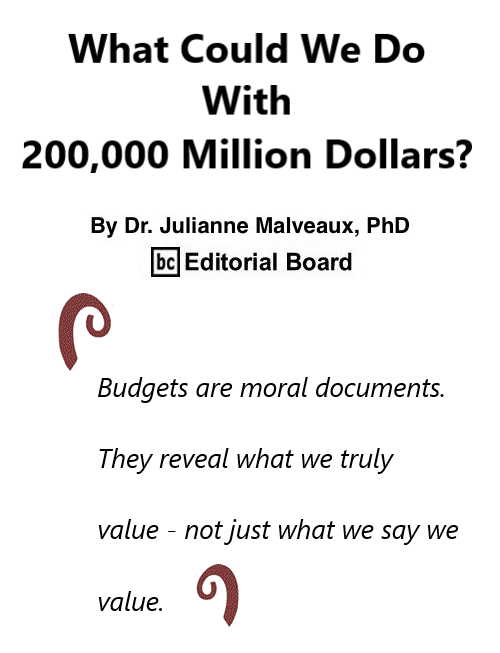
Budgets are moral documents. They
reveal what we truly value - not just what
we say we value. The numbers tell the story.
We can
find 200,000 million dollars for war
without hesitation. But when it comes to
investing in the futures of our own young
people, suddenly we
become very careful with the math.
We say we care about opportunity.
We say we care about education. We say we
care about closing the racial wealth gap.
But budgets tell the truth.
Show me our budget, and I’ll tell
you what we really value.
Or perhaps the question is even
simpler:
If we can find 200,000 million
dollars for war, why can’t we find the will
to spend even a fraction of it building the
future?