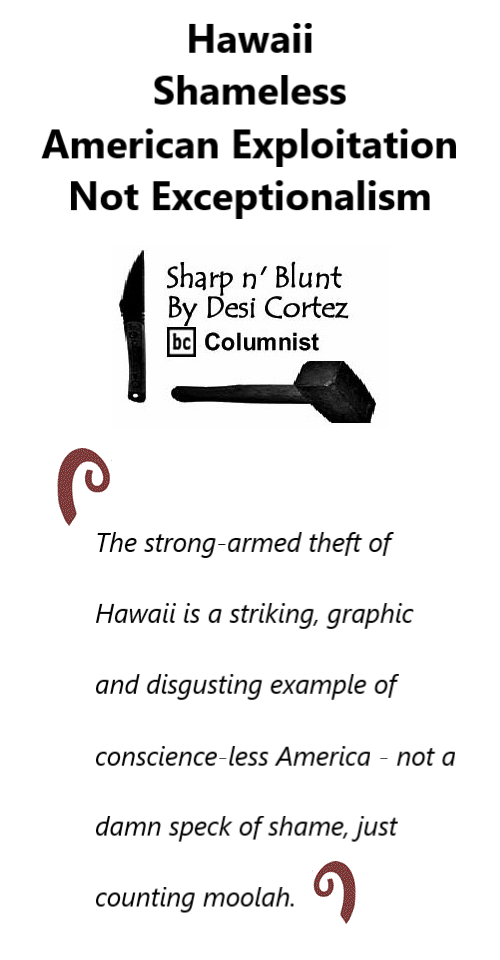
Hawaiʻi
stands as one of the nastiest, most
shameless examples of American
exploitation
ever
doused in the bargain-bin cologne of “exceptionalism.”
It was not sweet-talked into the Union. It
was snatched,
“shaken-down,” and stolen under the shadow
of armed force, then
gift-wrapped in red, white, and blue so the
mugging could pass for
Manifest
Destiny.
That is the American trick, isn’t it? Steal
the land, bless the
theft, plant the flag, and then lecture
everybody within earshot
about freedom. Hawaiʻi was not embraced. It
was taken, marketed, and
folded into the empire the way a pickpocket
slips a stolen wallet
into his own coat and then struts off
calling himself respectable.
In
1893, sugar barons, plantation bosses, and
their political errand
boys helped shove aside the lawful Hawaiian
government, and even the
U.S. government’s own record later admitted
that American
diplomatic muscle and naval power helped
make the theft possible.
Then came annexation. Then statehood. Then
came the old mainland
grift in its Sunday best: steal the kingdom,
bottle the beauty, sell
the view, market the hula, militarize the
land, and call the whole
sticky-fingered enterprise freedom. That is
the American talent,
after all. Rob the house, hang a flag in the
window, and then stand
on the porch grinning like you built the
place yourself.
That
was not exceptionalism.
That was imperialism
in
a nice hat, colonialism
with
a hymn book, exploitation
in
a pressed suit pretending it came to help.
The
Comanche, Arapaho, Apache, Sioux, Alaska
Natives, and Native
Hawaiians all
know that tune by heart. America has always
had a real talent for
taking somebody else’s land, gutting their
sovereignty, and then
asking the survivors why they are not more
grateful for the
privilege. Hawaiians were not gathered into
some noble democratic
embrace. They were folded into an empire
that wanted the ports, the
sugar, the military position, the land, and
later the postcard
fantasy. In the American imagination,
paradise is rarely a place to
respect. It is a place to monetize.
I’m
agitated because of what is right, because
of history, and because my
daughter is in college at UH Mānoa. Her
mother and I have made a few
trips there. We went there for spring break
(of course, what a perk)
a couple of weeks ago, in the middle of the
2nd wave of Super-storms,
and we got an up-close, firsthand look at
what neglect and
exploitation look like. We made it over to
Hilo to check out the
volcano. We missed the thousand-foot hot
lava fountains, but what we
did not miss was the larger truth. We found
exactly what any honest
person with both eyes open ought to expect:
the theft still pays
dividends for everybody except the people
who live there.
First
and foremost, Native Hawaiians, the
Indigenous people, the original
owners and spiritual heirs of the land, are
still too often treated
like strangers in the very home stolen from
their ancestors. They are
expected to live inside a paradise their
forebears once governed,
while watching outsiders buy, brand, rename,
rezone, and monetize
what was never rightfully theirs to begin
with. The people whose
blood, bones, memory, and culture are tied
to those islands are too
often pushed to the margins of decisions
about land, housing,
education, water, and development, as if
they are some noisy
afterthought rather than the first people of
that place. That is the
cruelty of the arrangement. Then there are
the “local” folks born
and raised in Hawaiʻi, many, most of them
not ethnically Native
Hawaiian but still island to the bone,
shaped by the place, loyal to
the place, and too often treated like
background scenery whenever
power, money, and real investment get passed
around. American on
paper, sure, but frequently handled like
they are extra luggage in
their own home. And both groups are expected
to play their part in
the same tired little colonial pageant:
smile for the tourists, keep
the machine running, and watch the money
board the next plane out.
That is the setup. That is the hustle.
Everybody local is told to
grin while somebody else counts the
receipts.
Pimpin’
Big-Time.
And
nowhere is that arrangement more insulting
than at UH Mānoa, where
the neglect is so old it ought to have
tenure. The University of
Hawaiʻi system has reported a
deferred-maintenance backlog in the
billion-dollar range, and an internal audit
of Mānoa student housing
described conditions at a Level 5 for both
custodial and maintenance
services, the bottom rung on the scale,
meaning neglect, crisis
response, broken equipment, and untimely
repairs are not exceptions
but the atmosphere. The same audit laid out
extensive preventive and
deferred-maintenance needs across housing
facilities. So yes, the
campus is beautiful. It does sit at the base
of the iconic Diamond
Head. The air is lovely. The palms still
sway. But beauty can become
camouflage when buildings, dorms, systems,
and student life are being
held together with patchwork, prayer, and
administrative
throat-clearing.
The
public school system, K through 12, is in
desperate need of increased
funding, top-to-bottom. Affordable housing
is extinct, and that was
not by happenstance, but rather it was
deliberate. Exclude the
indigenous riff-raff. Just like on the
mainland.
And
let’s quit playing dumb about who could help
fix it.
Marriott, Hilton, United Airlines -
the list is significant. The industries that
print money in Honolulu,
the tourism giants, developers, hotel
chains, airlines, defense
contractors, real-estate speculators, the
U.S. armed services, and
finance boys with leis around their necks
and spreadsheets in their
briefcases could do far, far more. Much
more. They could help rebuild
dorms, support faculty housing, invest in
classrooms, upgrade
facilities, and stop treating the flagship
university like some
decorative plant in the lobby of the
Hawaiian economy. But they do
not want to. There is no guilt there. No
moral itch. No sense of
stewardship. No embarrassment. They are too
busy counting money with
one hand and waving a tiny state flag with
the other.
The
strong-armed theft of Hawai’i is a striking,
graphic and disgusting
example of conscience-less America - not a
damn speck of shame, just
counting moolah.
And
if anybody still needs a case study in this
one-sided pimp
relationship between Hawaiʻi and American
business, pull up a chair
and stare straight at the Wahiawā
Dam.
Dole
had
known for decades that the dam could fail in
heavy rain and threaten
thousands of lives. The company was cited
repeatedly for deficiencies
and fined for missing deadlines, yet still
dragged its feet for
years. Now that the problem has ripened into
a public danger, the
repair bill runs into the tens of millions,
and the pressure shifts
toward government and taxpayers to help
clean up a mess attached to
land and profit Dole
enjoyed
for generations. There it is in one ugly
little snapshot: private
gain, public risk; corporate profit, local
burden; mainland
extraction, island consequence.
That
is not partnership.
That is pimping
with
paperwork.
Then
the storms came, because history apparently
enjoys adding insult to
injury. Governor Josh Green said the recent
Kona low storms and
floods brought catastrophic flooding,
landslides, infrastructure
damage, emergency evacuations, and losses
expected to exceed $1
billion. Roads, bridges, utilities, public
facilities, homes,
schools, and even a hospital were hit.
And
what does the response pattern tell us?
The
same thing it always tells us. When Hawaiʻi
is open for profit, the
corporate boys show up in linen shirts,
polished loafers, and
boardroom smiles. When Hawaiʻi is drowning
in mud and floodwater,
suddenly the help gets mighty thin. A little
weak assistance here. A
token gesture there. A few branded acts of
sympathy. A
camera-friendly oversized check. A press
release thick with
compassion and thin on cash. The heavy
lifting, as usual, falls on
nonprofits, local groups, volunteers,
mutual-aid networks, and
everyday people. Empire loves a view. It
just hates maintenance. And
capitalism loves an island most when the
island is low-maintenance
while being endlessly profitable.
That
is why Hawaiʻi is not some side story. It is
the
story.
It is a mirror. It illustrates in vivid
technicolor the same
arrogant, hostile mentality now stomping
around the globe under
Trump, the belief that power gives you the
right to decide who
governs whom, who owns what, and who is
supposed to shut up and call
domination order. Trump joined Benjamin
Netanyahu and started talking
in the language of obliteration and total
force, threatening
catastrophe on a scale that brushes right up
against global
thermonuclear madness, all while serving
distraction, pleasing
powerful benefactors, and protecting the
profit margins of his Wall
Street and investor-class homies. Attacking
Iran has not a damn thing
to do with helping the Iranian people.
White
man, please.
That
is not “diplomacy.”
That is “imperial
management”
in
a cartoonish necktie. That is not a
president talking. That is a
mafia landlord with the nuclear codes, a
small, weak man with a
frat-boy bully’s imagination who looks at
the earth like a dingy
strip mall full of storefronts he can seize,
reassign, or threaten
into blind obedience.
Hear
me now! The
mindset that helped rationalize the
overthrow of Hawaiʻi never died.
It’s alive and still demented, drunk with
misplaced arrogance.
And
because plain old domination is never enough
for these people, now
comes the machine part. Anthropic
fought
back after the Pentagon moved to blacklist
it as a national-security
supply-chain risk, following the company’s
refusal to let its AI be
used for military surveillance and
autonomous weapons. A federal
judge said the move looked like punishment
for the company’s views
on AI safety. That
matters. A
lot. Because when a government this cruel,
this vain, and this
power-hungry starts demanding unrestricted
AI for surveillance and
killing, you are no longer talking about
national defense. You are
talking about scalable control. Cheaper
repression. Faster force.
Cleaner paperwork for dirtier deeds. The
robo-soldier state is not
fully assembled yet, but the blueprint is
sitting right there on the
table, coffee-stained, half-signed, and
grinning like a grave robber.
So
let’s stop pretending Hawaiʻi is some happy
little star on the
flag proving America’s goodness. It is one
of the clearest case
studies in “how” this country really
operates when money,
military power, and racial hierarchy all
climb into bed together.
Gross!!! First the kingdom was taken. Then
the beauty was
commodified. Then the people were sidelined.
Then the institutions
were neglected. Then the corporations came
to dine. Then, when the
infrastructure cracks, the dorms rot, the
dam ages, and the
floodwaters rise, the same old script comes
sliding out of the
drawer: just enough help to calm the
headlines, not enough to change
the condition. That is not exceptionalism.
That is exploitation with
better branding. That is pimping paradise,
starving the house, and
expecting the tenants to sing aloha while
the rainforest and beaches
are raped for all their value.