I heard
about the United Nations General
Assembly’s resolution on slavery about the
same time I finished reading The
Zorg: A Tale of Greed and Murder
that Inspired the Abolition of Slavery by
Siddharth Kara. The resolution declared
the transatlantic chattel slave trade as
the “gravest crime against humanity.” It
affirmed reparations as a necessary step
towards “remedying historical wrongs,” an
echoing demand for centuries from
descendants of the transatlantic slave
trade.
The
Zorg filled critical gaps in my
understanding of the slave trade that I
had never given much thought to. My dogged
focus was always on two things: the
treacherous journey from the Motherland to
North America, and our existence once we
arrived on these shores. I never thought
about the sophisticated infrastructure of
the slavery trade. Four centuries?
Insurance companies? Medical personnel as
ship crew? Pirates?
Kara’s research is detailed,
informing a riveting storyline. The subject
matter is hard enough to deal with, but the
author spares no mercy in forcing the reader
to push our noses into the stench of the
slave trade’s inherent depravity. He was
quite vivid in his accounting of the horrors
heaped upon Black bodies, whether at sea or
on land.
So, when the UN Assembly took its
vote, my heart and soul were right there.
March 25 commemorates the International Day
of Remembrance of the Victims of Slavery and
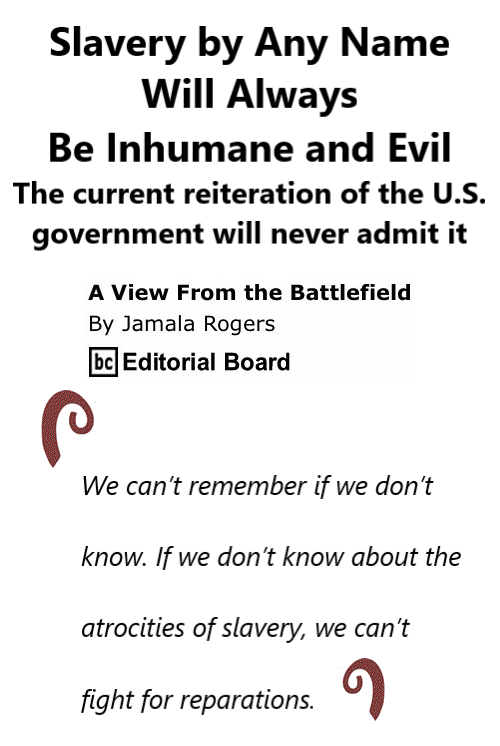
the Transatlantic Slave Trade. We can’t
remember if we don’t know. If we don’t know
about the atrocities of slavery, we can’t
fight for reparations.
It was expected that the U.S.,
Israel, and Argentina would be flat out
opposed to the resolution. It was no
surprise that the European countries
abstained. As former slavery traders and
colonizers, their refusal to acknowledge
their role was predictable.
It was a mirror response to the
declaration drafted at the 2001 UN
Conference on Racism in Durban, South
Africa. Many of us saw the declaration as a
labor of love as we lobbied NGOs and
official government delegates to recognize
“slavery and the slave trade as crimes
against humanity.” The declaration, and any
momentum it would have, was brought to a
screeching halt with the attack on the World
Trade Center. Our excitement to push the
U.S. reparations movement was temporarily
diverted to organize against the repressive
laws passed in the name of national security
and anti-terrorism.
The lesson of the unlikely alliance
of abolitionists and the insurance companies
to force the courts to rule on the humanity
of slaves is not lost on this strategist. I
believe that the purity of the social
justice movements is preventing the
formation of such bold relationships and
coalitions around a radical agenda to secure
reparations.
The
demand for restitution for the
consequences of slavery and colonialism is
legitimate. The struggle for reparations
is a righteous one and will never die. As
a literary classic, The
Zorg has made a compelling
contribution to the case for African
reparations.