I
was raised Catholic.
Not
casually
Catholic. My mother was the kind of
Catholic who went to
Mass every day. Faith was not something
she talked about; it was
something
she did. In our aqua-blue kitchen, she had
the lyrics, in white
paint, “Holy Mary, dressed in blue, teach me
how to pray.” She
prayed without ceasing, and her prayers were
deep and strong.
I
went to a Jesuit college, Boston College,
where faith was woven into
the intellectual life - questions of
justice, responsibility, and
what it means to live a life of purpose. It
wasn’t always
comfortable, but it was always present.
So
when I hear people arguing about the pope as
if religion were a
political sport, I find myself out of step
with the conversation,
because that’s not the faith I knew.
The
noise is everywhere. Commentary about Pope
Leo - what he said, what
he meant, who agrees, who doesn’t - fills
panels and social media
feeds, turning belief into a series of
takes. It is loud and, for the
most part, unhelpful.
We
have developed a habit of treating religious
figures like political
ones, as if they occupy the same space. They
don’t. Political
leaders govern behavior, while religious
leaders, at their best, try
to speak to conscience. But we have grown so
accustomed to spectacle
that even conscience has to compete for
airtime.
The
numbers tell us something is changing.
Church attendance in the
United States has been declining for years,
and fewer people claim
formal affiliation. Yet nearly nine in ten
Americans say they believe
in God or some higher power. Many are no
longer sitting in pews, but
belief persists. We measure what is easiest
to count - attendance,
affiliation, participation - but not what is
harder to see: practice,
discipline, belief.
Faith,
as I understood it growing up, was never
about being seen.
My
mother did not go to Mass every day so
someone could check her
attendance. She went because that was how
she ordered her life -
discipline, gratitude, and a quiet
insistence that there was
something larger than whatever the day might
bring.
My
own relationship with Catholicism has been
more complicated. I don’t
come to this conversation as a defender of
the Catholic Church; I
come as someone shaped by it, challenged by
it, angered by it, and
still, in some ways, holding onto it.
As
soon as I learned about the Church’s
historical role in sanctioning
enslavement, I was repulsed - and I made my
opinion known, quite
vocally: skipping Mass, arguing with
priests, and sometimes
embarrassing my mother. Sexual abuse in the
Church repulses me. The
betrayal of trust, and the lengths taken to
conceal it, stand in
painful contradiction to the values the
institution professes. The
codified inferior role of women has never
sat easily with me either.
It
is undeniably an imperfect church, but its
imperfections do not
diminish its relevance.
Years
ago, I wrote about the patriarchy embedded
in the Church, and one of
my small, symbolic protests has been ending
prayers with “amen,
a-woman,
and ase’.”
Inequality does not disappear simply because
we believe in our
Creator. A mentor once asked whether I could
point to any institution
entirely free of racism or sexism. I could
not.
When
I hear that we are created in the image and
likeness of God, I find
myself looking for a stained-glass window
with a pecan-colored woman
with gray dreadlocks. I haven’t seen one
yet.
And
still, the quiet, practiced kind of faith
does not lend itself to
commentary, nor does it disappear simply
because fewer people are
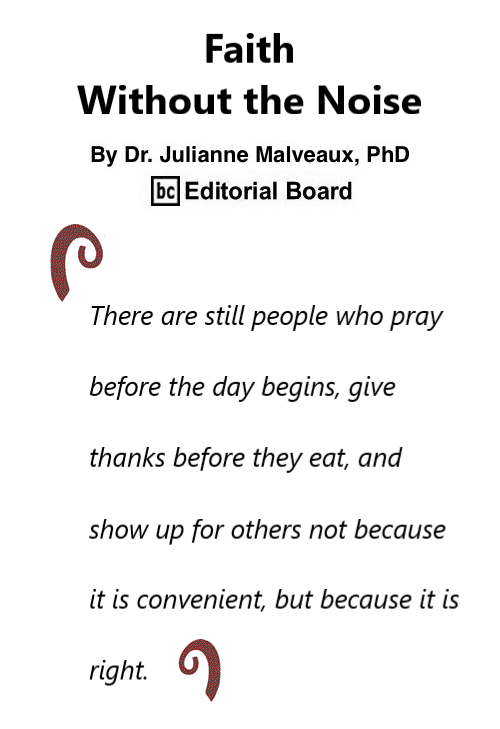
sitting in church. There are still people
who pray before the day
begins, give thanks before they eat, and
show up for others not
because it is convenient, but because it is
right.
It
is also worth noticing the signals we choose
to see. Pope Francis had
chosen to live in modest quarters rather
than the traditional papal
apartments, a small but visible gesture in
an institution known for
grandeur. In a world accustomed to power on
display, that kind of
restraint stands out not because it is
dramatic, but because it is
not.
My
grandmother used to say that some people
come to God with their hands
out and their mouths open. It was her way of
reminding us that faith
is not only about asking, but about
recognizing, giving thanks, and
showing up with something other than need.
We
don’t talk much about that kind of faith
anymore. It doesn’t fit
neatly into our arguments or produce a
headline, but it may be closer
to what faith actually is.
If
nearly all of us believe in something beyond
ourselves, then the
question is not whether faith is
disappearing, but whether we have
misunderstood where it lives. It may not be
in the noise we amplify
or the arguments we keep having, but in the
quiet, daily practices
that go largely unseen.