The Constitution begins with three
powerful words: “We the People.” History
immediately asks: Which people?
When those words were written, “we”
did not include enslaved people, Indigenous
people, women or many white men without
property. Enslaved Black people were counted
as three-fifths of a person for
representation, although they had no
representatives of their own. From the
beginning, counting people has been about
power.
Now the Trump administration is
considering sweeping changes to the 2030
Census. Its proposal could exclude
undocumented immigrants and some people who
are legally present - including refugees,
asylum seekers and students - from
population totals used to divide seats in
the House of Representatives. The
administration is also reconsidering
questions about race and ethnicity. Reuters reported details of
the proposal here.
The census is not clerical
housekeeping. It is a ledger of power.
Numbers become congressional seats. Numbers
become federal dollars. Numbers become
schools, hospitals and highways. Change the
numbers, and you change who gets what.
The administration says people
without sufficient legal ties or allegiance
to the United States should not be included
in apportionment totals. Critics contend
that this approach conflicts with the
Fourteenth Amendment. Its language says
representatives must be apportioned
according to the “whole number of persons in
each state.”
Not citizens. Not permanent
residents. Persons.
An immigrant without citizenship is
still a resident. She rides the bus, buys
groceries and pays rent. He works, worships,
raises children and contributes to the
economy. Residents use schools, hospitals,
roads and emergency services. Governments
must plan for their presence regardless of
immigration status.
Excluding millions of residents
could produce a census that does not reflect
the population actually living here. It
could also shift House seats and Electoral
College votes away from states with large
immigrant populations. Those states would
not have fewer residents. They would have
fewer residents counted for representation.
There is an economic consequence,
too. Census Bureau data help guide trillions
of dollars in federal spending. The numbers
inform decisions involving health care,
housing, education, transportation,
nutrition and emergency services. In fiscal
year 2021, at least 353 federal programs
used census-related data in distributing
more than $2.8 trillion. The Census Bureau explains
how its data inform federal funding
here.
The census is economic
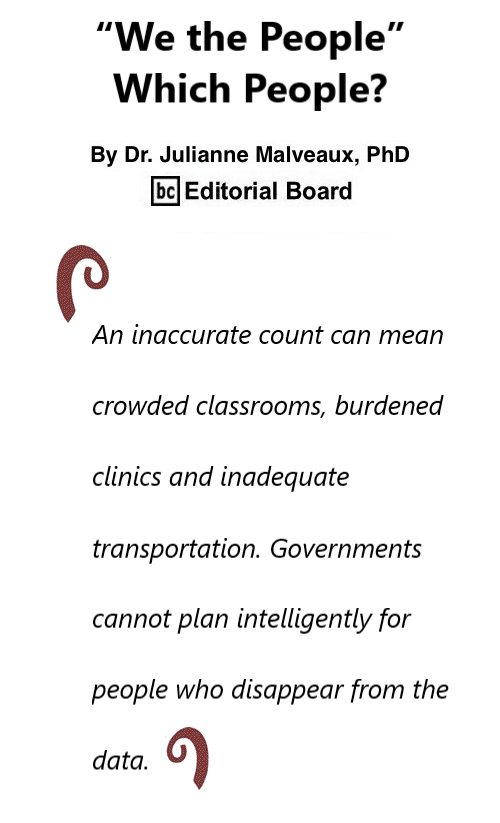
infrastructure. An inaccurate count can mean
crowded classrooms, burdened clinics and
inadequate transportation. Governments
cannot plan intelligently for people who
disappear from the data.
The possible elimination of
questions about race and ethnicity raises
another issue. Race is a social construct,
not a biological fact. Yet racial data are
used to identify disparities and enforce
civil-rights protections. Race may be
constructed, but racial inequality can be
measured.
Without those data, how do we
document disparities in employment, housing,
lending and education? How do we identify
differences in maternal mortality,
unemployment, income and wealth? How do
courts evaluate claims involving racially
polarized voting? How do communities
determine whether public investment is
reaching them?
Eliminating racial categories would
not eliminate racial disparities. It would
make those disparities harder to measure. If
the racial wealth gap is not measured,
officials cannot track whether it is
widening or narrowing. If Black women’s
employment losses are not reported
separately, their experiences disappear
inside national averages. If racially
polarized voting is not documented, certain
forms of discrimination become harder to
establish in court.
No numbers, no evidence. No
evidence, no accountability.
The census has never been racially
innocent. The original count accommodated
slavery. Later counts used crude and
demeaning racial classifications. Census
categories have reflected the prejudices,
assumptions and power arrangements of their
times. That history calls for better data,
not statistical blindness.
What does this have to do with the
2026 midterms? The November election will
not use the 2030 Census. But the Congress
elected this year will serve during critical
years of census development, testing and
preparation. It will appropriate money for
the Census Bureau, conduct oversight, hold
hearings and consider legislation affecting
the count. The midterm connection is not
rhetorical. It is institutional.
The census is conducted by the
executive branch, but Congress controls
funding and exercises oversight. The
composition of Congress will therefore
influence how closely proposed changes are
examined, which questions officials must
answer and whether the Census Bureau has the
resources to conduct an accurate count.
The census does not belong to one
president or one party. It is a
constitutionally required count with
consequences that last an entire decade.
Changes this sweeping invite public
scrutiny, transparent methods and
constitutional review.
“We the People” began as an
aspiration, not an accurate description of
American democracy. Generations of excluded
Americans fought to enlarge the meaning of
“we.” They transformed constitutional
language into demands for citizenship,
representation, equality and justice.
The question remains as old as the
Constitution itself: Who are “We the
People”?
Before America can answer, it must
decide who will be counted.