Upon
hearing that the U.S. Supreme Court’s six
conservative justices had
callously dismantled
to the last vestiges the landmark 1965
Voting Rights Act (VRA), I,
like millions of other Americans, were
simultaneously outraged and
psychologically spent. A 6–3 U.S. Supreme
Court decision eradicated
a vital segment of the 1965 VRA, leaving
Black voters nothing short
of politically adrift. Its
6–3 ruling in Louisiana
v. Callais
struck down a Louisiana congressional map
that had resulted in a new
Black-voter majority district. The majority
opinion by right wing
justice Samuel Alito argued (unconvincingly)
that they were saving
the 1965 VRA by nullifying it and that
political maps like the ones
that currently have 23
Black House members from former
Confederate states
are supposedly racist - because they
discriminate against White
people.
Section
2 of the VRA,
which outlawed voting practices that
culminated in minority voters
having less opportunity than others to
participate in the political
process and select their preferred
politicians, has effectively been
revoked by the court. The decision grants
permission for Republican
states, seeking to eliminate districts where
voters of color form the
majority, the opportunity to do so. These
are districts that tend to
lean politically Democratic,
and they are traditionally the center of
Black political power.
Immediately following the court ruling,
various Southern politicians
hailed the decision and declared that their
states should move
forward to increase Republican
representation. This decision has
provoked widespread condemnation. Slate’s
Richard L. Hasen ranked it as maybe
the worst Supreme Court ruling
of the last century; that in pandering to
aggrieved White
Republicans,
the conservative majority had created “a
disaster for American
democracy.” The normally politically
diplomatic New
York
Times
editorial board dramatically blasted
the decision,
referring to it as “a mind-boggling piece of
judicial overreach”
in which “the court has acted more like
partisan legislators than
like impartial judges.”
It
is not an overstatement to argue that the
outcome of such draconian
legislation will probably result in the
greatest deficit of voting
power from Black Americans since the end of
Reconstruction and the
establishment of Jim Crow. Such a decision
is the integration of Dred
Scott
v. Sandford
and Plessy
v.
Ferguson.
It
will be difficult to pinpoint how many seats
Democrats will be
deprived of in the Republican redistricting
smorgasbord that the
court’s decision has granted. The New
York
Times
reported that the ruling would jeopardize
about a dozen
Democratic-leaning seats throughout the
South. A
report
by Fair Fight Action, the voting rights
group, recently
declared
that Republicans could pick up as many as
two dozen seats. A few of
these will be quickly captured in the
November 2026 primaries, with
Republican-controlled states rabidly
implementing regressive methods
to eradicate majority-minority districts
that had been previously
mandated by what remained of the VRA. Others
will incrementally move
toward Republicans over time as statehouses
reorganize their
districts ahead of next year’s special
elections and the 2028
cycle.
Many
on the political right are lauding this
decision as a victory for a
“colorblind” constitution. However, the truth
is that ignoring
and denying racial discrimination does not
nullify it. Racism is a
disease that requires a diagnosis. Without
Section 2 or the political
tools to respond to patterns of
discrimination, it will be a largely
futile effort to prohibit future legislative
districts from
resembling the racial demographics they did
during the Jim Crow era.
For the past sixty-one years, the VRA has
provided civil rights
advocates and the federal government vital
ingredients necessary to
outlaw racial discrimination in voting. The
current supreme court
treats the law’s very success as the reason
why it is no longer
necessary. This is a shortsighted and arguably
disingenuous position
to take.
Justice
Alito’s opinion (who wrote for the majority)
repeals the 1982
reauthorization
of the VRA,
which specifically demanded that voting
district maps should be drawn
in a way that preserved the competitive
representation of racial
minorities - and that mere discriminatory
impact was reason enough to
render maps illegal, with no evidence of
discriminatory intent
required. Discarding congressional intent
entirely, Alito
claims
that this provision was unconstitutional due
to the fact that to
ensure duplicative representation for Black
voters, redistricting
bodies have to consider race. This, the
court contended, constitutes
discrimination against non-Black voters.
Such an argument reeks of
intellectual dishonesty. Justice Alito, the
other justices, and many
other Americans are well astute to the
reality that racism remains a
potently vile and adversarial factor in the
lives of many people of
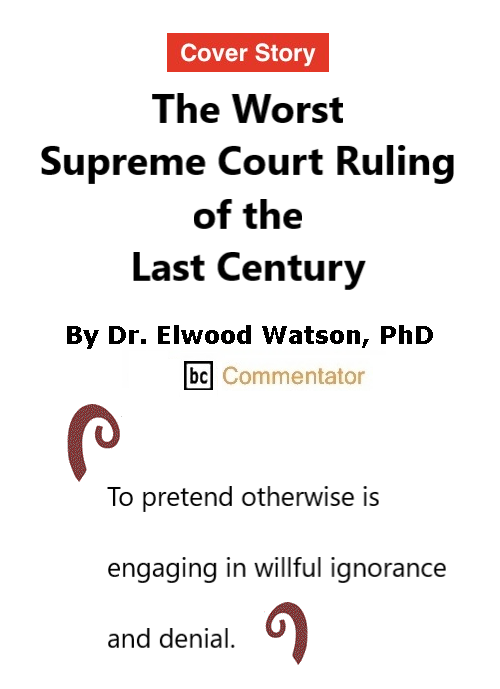
color. To pretend otherwise is engaging in
willful ignorance and
denial.
We
are moving backwards at an alarming rate. It
took the VRA to make the
dreams of the Reconstruction amendments to the
constitution real.
That horrific chapter also belongs to the
supreme court of the 1870s.
In a series of cases, the court greenlit
decades of Klan and White
League terror acts across the South and
Southwest. The court’s
steady erosion of the Reconstruction
amendments - together with its
evisceration of congressional efforts such as
the Enforcement and
Civil Rights Acts - smothered the civil rights
movement in the former
slave South. The high court also permitted
state constitutions to
effectively wipe out Black voting rights,
launched decades of Jim
Crow suppression of the vote, and nullified
any hope of civic or
socioeconomic equality. The upshot of all this
regressive and cruel
lawmaking from the bench was to erect a regime
of injustice and
inhumanity nearly as repugnant as slavery
itself.
The
majority of this right-wing court sinisterly
aligns with them in
infamy. Both courts, in the last third of the
nineteenth century and
the recent, previous decade have been all too
willing to refuse to
acknowledge that institutional, systemic, and
systematic racism are
perennial factors that have and continue to
exist, and they have
rather perversely opted to terminate updated
federal safeguards of
the vote under the guise of a supposedly
color-blind society that has
never existed. Justices on both courts viewed
protecting the right to
vote as a racial entitlement that gave undue
preference to Black
citizens.
The
truth is that the conservative right has
shrewdly and strategically
(albeit in a perverse and sinister manner)
played the long game.
Republicans took cognizance of the success
that the left had garnered
during the 1960s, such as its monumental
victories with the Civil
Rights Act (1964) and the VRA (1965),
culminating with the
ratification of Roe in the early 1970s.
Conservative activists then
realized that they could employ similar
strategies in their efforts
to abolish such progress.
This
decision will dramatically reduce racial
diversity in Congress, most
state legislatures (Southern state
legislatures), and local
jurisdictions such as city councils, by
obliterating the protections
of Section 2 of the act which had allowed a
pathway to guarantee
non-White voters would be provided some basic
and equitable
representation. Justices John Roberts and
Samuel Alito have
demonstrated tenacious opposition to the
belief of the United States
as a diverse and pluralistic democratic
society, and they have also
showcased a blatant desire to arrogantly
discard Congress’s
perspective that judicious participation for
minority voters
occasionally requires that race-conscious
remedies be implemented.
Such a demonstrably unjust verdict provides
many right-wing
jurisdictions with the tragic ability to
further politically engineer
racially partisan gerrymandering.
Additionally, it provides
considerable ammunition for conservative,
right wing (primarily
White) Republican voters. We are currently in
politically dark days
in America.
|
|