Elections
aren’t supposed to stop midstream, but in
Louisiana, they did.
After the Supreme Court stepped into the
state’s redistricting
fight, Governor Jeff Landry halted
congressional primaries that were
already underway. People were voting, and
the rules changed in real
time. That is not a technical glitch. It is
power being exercised -
and protected.
This
is not about lines on a map. It is about who
holds power and how that
power determines who gets resources. The
Court has long treated
partisan gerrymandering as a “political
question,” something it
prefers to avoid. Even when it intervenes on
racial grounds, as in
Allen v. Milligan, the result is rarely
resolution. States redraw
maps, courts revisit them, and uncertainty
lingers. In Louisiana,
litigation like Robinson v. Ardoin has
created a cycle rather than a
solution, leaving elections - and voters -
caught in the middle.
There is nothing new about this. After
Reconstruction, when Black
political power briefly expanded, it was met
not only with violence
but with precision. District lines were
drawn to contain that power,
ensuring that even when Black people could
vote, their votes would
not translate into governing authority.
In
1868, Benjamin Franklin Randolph, a Black
state senator in South
Carolina, was assassinated in broad daylight
at a train station in
Abbeville. His killing was not random. It
was part of a broader
campaign to suppress Black political
leadership - not just at the
ballot box, but through terror. The methods
have changed over time,
but the objective of controlling Black
political power has not.
Today’s
gerrymandering uses more sophisticated
tools, but it serves a
familiar purpose. When districts are
engineered to predetermine
outcomes, accountability erodes. Elected
officials do not have to
persuade broad constituencies or compete for
every vote. Too often,
they do not have to deliver.
And
when officials do not have to deliver,
resources follow power rather
than need. That is where the economic
consequences become
unmistakable.
Communities
with diminished political influence are less
able to secure
investment. Schools go unrenovated.
Infrastructure projects stall.
Hospitals struggle or close. Broadband
expansion stops just short of
the neighborhoods that need it most. These
are not isolated failures;
they are the cumulative effects of political
decisions shaped by
distorted maps. Over time, those decisions
constrain opportunity,
limit mobility, and reinforce inequality.
This
is how gerrymandering feeds the racial
wealth gap - not through a
single dramatic act, but through
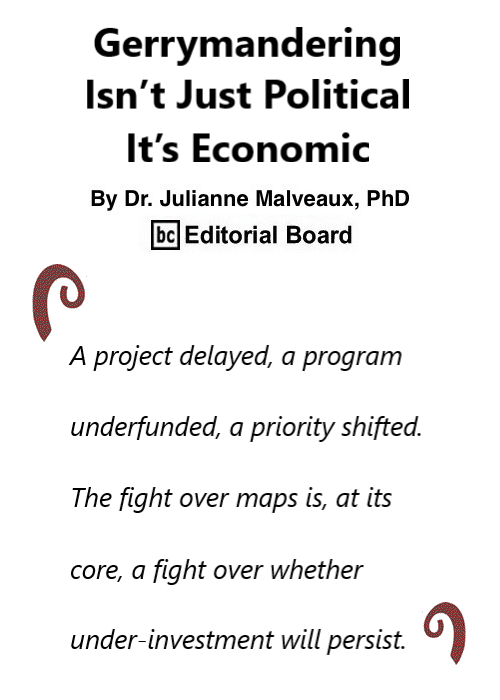
accumulation. A project delayed, a
program underfunded, a priority shifted.
Each decision may seem
small, even routine. Together, they produce
disparities that are then
treated as inevitable rather than
engineered.
Black
communities have experienced this pattern
for generations. Whether
through “packing,” which concentrates Black
voters into a small
number of districts, or “cracking,” which
disperses them across
many, the result is the same: diminished
influence. Diminished
influence translates directly into
diminished economic capacity.
Representation
is not symbolic; it is distributive. Who
counts politically
determines who receives investment,
protection, and opportunity.
Louisiana’s current turmoil makes that
reality plain. When
elections can be halted and maps redrawn in
real time, the rules of
representation themselves become tools of
power. And when power is
managed, so is the flow of resources.
Alabama
offers a parallel lesson. The Supreme
Court’s decision in Allen v.
Milligan acknowledged that Black voters were
being shortchanged under
the Voting Rights Act, but that recognition
did not end the struggle.
It simply opened another phase in a
continuing contest over
representation and investment. The fight
over maps is, at its core, a
fight over whether under-investment will
persist.
Gerrymandering
is not the only driver of economic
inequality, but it is one of the
most durable and least visible. Distorted
maps produce distorted
outcomes, and over time, distorted
economies. We debate maps as if
they are abstractions. They are not. They
are blueprints for who
prospers - and who does not.