They
are calling it a budget cut. But let’s be
clear: when Congress cuts
WIC, it is taking food from pregnant women,
babies, toddlers, and
young children.
WIC
is not cash welfare. It is not a giveaway.
It is one of the most
efficient and humane nutrition programs this
country has ever
created. It provides targeted food support,
breastfeeding support,
nutrition counseling, and health referrals
to pregnant and postpartum
women, infants, and children up to age five.
It helps families buy
milk, eggs, cereal, formula, fruits,
vegetables, and other basics
that make the difference between nourishment
and hunger.
Now
the House has decided that these families
should do with less.
On
June 4, the House passed the FY2027
Agriculture appropriations bill,
including a $200 million cut to WIC and a
reduction in the
fruit-and-vegetable benefit. For a family
already stretching every
dollar, that is not an abstraction. That is
fewer apples. Fewer
greens. Less formula. Less food at the very
moment when food matters
most.
The
numbers are stark. The House bill cuts WIC
by $200 million and
reduces the fruit-and-vegetable benefit. The
White House proposal
goes even further, slashing the monthly
produce benefit for young
children from $26 to about $10. That is a
$16 cut per child each
month - more than 60 percent - in the very
part of WIC designed to
put fresh food on the table.
Some
will say that $16 a month is not much. But
$16 is only “not much”
to people who have never been down to their
last $16. For a family
living on the edge, $16 is milk and bananas,
eggs and apples, bus
fare to the grocery store, or the difference
between buying fresh
food and buying the cheapest calories
available. A cut does not have
to be large to be cruel. Sometimes the last
$16 is the last straw.
This
is what cruelty looks like when it wears a
green eyeshade.
We
are told, endlessly, that this nation cares
about children.
Politicians pose with babies, praise
mothers, salute families, and
campaign on “values.” But values are not
measured by slogans.
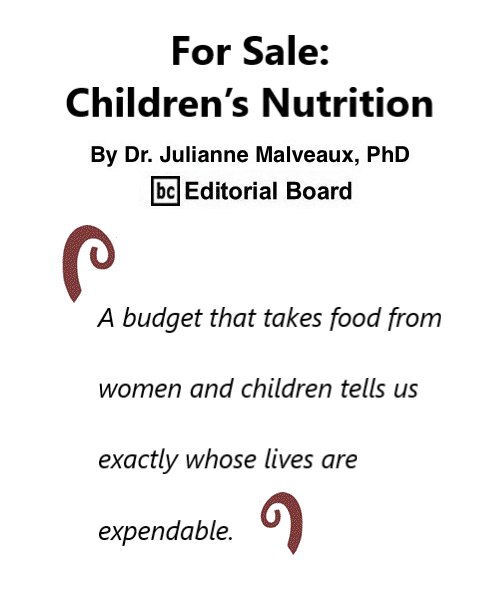
They are measured by budgets. And a budget
that takes food from women
and children tells us exactly whose lives
are expendable.
WIC
also supports farmers, grocers, and local
food economies. When a
mother uses WIC dollars to buy fresh fruit,
vegetables, milk, eggs,
cereal, or formula, that money does not
disappear. It goes to grocery
stores, farmers markets, dairy producers,
food distributors, and
growers who depend on regular customers.
Less WIC money means fewer
purchases of healthy food. It means fewer
dollars circulating in
local communities. It means that a cut aimed
at poor women and
children also reaches farmers and small
businesses. Nutrition dollars
are economic dollars, too.
That
is especially important because healthy food
is already too expensive
for too many families. Fruits and vegetables
are often the first
things to disappear from a household budget
when money gets tight.
WIC helps keep those foods on the table.
Cutting the
fruit-and-vegetable benefit does not simply
reduce choice; it narrows
possibility. It tells a mother to stretch,
substitute, and make do.
It tells a child that fresh food is
optional. It tells farmers that
the public dollars that helped families buy
their produce are no
longer a priority.
What
kind of country negotiates over the
nutrition of infants? What kind
of Congress looks at pregnant women and
toddlers and says, “You
cost too much”? What kind of moral
arithmetic takes fresh fruit and
vegetables from a child’s plate while
protecting tax breaks,
weapons contracts, corporate subsidies, and
political theater? What
kind of Congress spends nearly $2 billion a
day on an undeclared war
against Iran, then skimps on food for
children?
The
House has acted, but the Senate has not
finished its work. Final
negotiations are still ahead. That means
advocacy matters now. Not
next month. Not after recess. Now.
The
ask is simple: fully fund WIC. Reject cuts
to the fruit-and-vegetable
benefit. Preserve the virtual and remote
services that make WIC
accessible to working mothers, rural
families, and those without easy
transportation. Do not balance the budget on
babies.
The
United States can find money for tax breaks,
weapons, walls,
corporate subsidies, and billionaire
giveaways. Surely it can find
money for bananas, carrots, milk, cereal,
formula, and breastfeeding
support.
The
families who rely on WIC are not asking for
luxury. They are asking
for food. They are asking for nourishment.
They are asking for a
basic public commitment that babies should
not go hungry, that
pregnant women should not be undernourished,
and that children should
have access to the building blocks of
health. That should not be
controversial. It should be the floor
beneath our politics.
When
children are hungry, delay is a decision.
When pregnant women are
undernourished, silence is complicity. And
when Congress chooses
austerity for babies while protecting
abundance for the powerful, we
should name it for what it is.
This
is not fiscal discipline.
It
is moral failure.