Nineteen-year-old
Karmelo
Anthony
was convicted of murder
on June 9 and sentenced to thirty-five years
in prison for fatally
stabbing seventeen-year-old Austin Metcalf at
a high school track
meet in April 2025 in Frisco, Texas. Frankly,
the conviction didn’t
surprise me. From the incident’s initial
stages to the jury’s
composition and other factors, the political
and judicial winds were
clearly blowing in the prosecution’s
direction.
From
the outset, the case garnered intense national
media attention. It
was about a harrowing physical altercation
that escalated to murder.
It did not take long for inaccurate
information about both young men
to saturate social media. Grotesque lies and
malicious, targeted,
menacing campaigns emanated from across the
political spectrum, and
both men’s family members were disturbingly
the targets of
aggravated harassment. Conservative right-wing
organizations eagerly
latched on to the case, for one obvious
reason. Anthony is Black,
Metcalf White.
Numerous
studies that the US
Sentencing Commission,
The
Marshall Project,
and the
Office of Justice Programs
conducted have exposed profound racial
disparities between Black
defendants and non-Black defendants charged
with serious crimes.
Black defendants routinely receive harsher
sentences than other
racial groups do when claiming self-defense.
Such
disturbing disparities are a major reason why
Karmelo Anthony’s
judicial saga has drawn rabid attention.
Anthony’s proponents argue
that his sentence raises justified questions
about consistency,
especially after he claimed self-defense. In
contrast, his detractors
argue that justice was served. Truth be told,
America has a long
history of cultivating racially polarizing
criminal trials based on
the racial dynamics involved. A Black
teenager’s killing of a White
teenager has been fertile ground for the most
intensely hate-filled
racist individuals to perversely amplify and
exploit endemic racial
tensions. The rise of AI has further
compounded the problem.
Consequently,
many observers, including me, have examined
the trial through a
broader historical and cultural lens. Some
have questioned whether
race influenced public reaction to the
incident, while others raised
concerns about fairness, appropriate
representation, and faith in a
judicial process that has often been anything
but equitable to Black
Americans. Indeed, Karmelo Anthony’s family
openly expressed
concerns about racial discrimination and
unequal treatment throughout
the legal proceedings and shared that they had
to move from their
original residence to protect their safety due
to racial
attacks
during the trial.
While
the verdict ignited fierce debate across the
political spectrum, in
social activist circles, and in the world of
legal punditry and other
segments of American society, one glaring
factor at the center of
everything is the
jury’s racial composition.
In
Collin County, where the trial occurred, Black
people make up 12.1
percent of the population, according to The
Dallas
Morning News.
Nonetheless, of the roughly several hundred
residents summoned for
jury duty, the jury ultimately comprised
twelve jurors and six
alternates, one of whom identified as Black.
According to CBS News,
the prosecutors dismissed the three qualified
Black jurors during the
final jury selection in spite of defense
attorneys’ accusing the
prosecutors of removing the jurors without
proper cause. They argued
with a straight face that the case’s
circumstances were
“race-neutral” (yes, you read that correctly)
and did not require
a diverse jury. Judge John Roach Jr.
ultimately sided with the
prosecutors.
The
sentence arrived as Anthony’s family and
supporters said they did
not believe he received a fair trial, and an
advocate claimed jurors
never saw a key video. The case is drawing
attention because the
murder, the verdict, and the fight over Black
jurors are now
colliding in a high-profile Texas murder
trial. “The prosecution
used its final strikes to remove the remaining
qualified Black jurors
from the jury pool, raising serious concerns
about fairness and equal
justice,” Next Generation Action Network, a
civil rights
organization, shared following jury selection.
“We respect the
court, but we will not remain silent.” Law
Professor Anna
Ofitt
confirmed
such concerns in an op-ed for The
Dallas Morning News,
pointing out that in Texas, the stakes of jury
composition are
particularly high because jurors don’t only
decide guilt or
innocence; they also decide the sentence.
The
exclusion of Black people from juries is
hardly a recent phenomenon.
On the contrary, it is often par for the
course and deeply American.
For centuries, the US Constitution effectively
denied Black
communities the right to serve on juries
through the machinery of
slavery. Even post-emancipation, many states
resisted providing Black
citizens access to jury service and the option
of a jury of their
peers trying them. The ratification of the 14th
Amendment
in
1868, which provided all citizens with “equal
protection of the
laws,” and the Civil
Rights Act of 1875,
which nullified race-based discrimination in
jury selection, legally
opened the door to Black Americans’ equal
participation in the
judicial process. Centuries later, the gulf
between legal protection
and lived reality remains stark.
Today,
that gap is even more pronounced when you
consider that nearly every
elected prosecutor in America is White,
despite the fact that more
than four out of ten Americans are non-White,
as
cited by the Equal Justice Initiative.
The constitutional right to a jury of one’s
peers exists precisely
to protect defendants from law enforcement,
judges, and racially
motivated prosecutors’ unchecked and all too
often unexamined
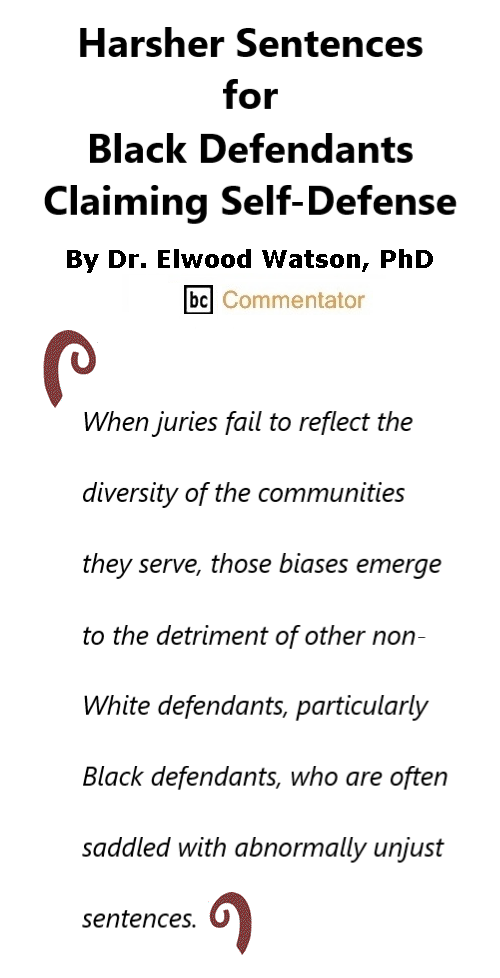
racial and cultural biases. When juries fail
to reflect the diversity
of the communities they serve, those biases
emerge to the detriment
of other non-White defendants, particularly
Black defendants, who are
often saddled with abnormally unjust
sentences.
The
fact that Karmelo Anthony is a dark-skinned
Black person
may
well have factored into the jury’s
deliberations. Several studies
have indicated that darker-skinned Black
people often receive harsher
sentences than lighter-skinned Black people
do. Anthony’s more
pronounced Blackness possibly turned off many
Whites, particularly
socially and culturally conservative Whites,
including those on the
jury. Such internal
entrenched biases
extend
beyond the judicial system.
To
be sure, a racial belief in the Karmelo
Anthony verdict has not been
universal. Several Black people, among them Jemele
Hill,
have argued that Anthony should have been
convicted but for a lesser
crime. To be honest, I could have understood a
manslaughter charge.
In my view, a thirty-five-year sentence for a
then seventeen-year-old
child with no prior criminal record and no
evidence of harboring any
pre-meditated motives in his altercation with
Mr. Metcalf is unduly
harsh and borders on cruel and inhumane
punishment. This sentence is
particularly unnerving when compared to what
previous defendants
received. For example, Aaron
Dean,
Elijah
McCain,
Johanes
Mehserle,
Daniel
Panteleo,
Chikei
Rick Chow,
George
Zimmerman,
Kyle
Rittenhouse,
Gerald
Stanley,
James
Burke,
Sonja
Du,
and
Caysen
Allison
were accused of taking the lives of Black
people, but most of them
were either acquitted or received minimal
sentences.
Such
outcomes demonstrate that in the US judicial
system, many Americans
perceive White people’s lives as significantly
more valuable than
the lives of others. A cold, sobering, and
unacceptable reality.
|
|