Recently, Jamaica and Namibia made
demands for reparations from their former
European colonial oppressors, a reminder
that the struggle for reparations for
slavery and genocide against Black people is
not just an American issue, but a global
matter.
In an
historic move, the Caribbean nation of
Jamaica petitioned Britain to demand £7.6
billion ($10.5 billion) in compensation for the
600,000 Africans that were shipped there
and forced to work on the plantations and
pick sugarcane, bananas and other crops.
Britain colonized Jamaica from 1655 until
1962, when the island became independent.
The notion of the UK paying reparations
for slavery only makes sense, considering
that when the British abolished slavery in
1834, the government took out a £20
million
loan to pay reparations - to the
slave
ownersfor their
loss of property. The
amount Jamaica seeks is equivalent to the
present value of the reparations paid to
slave owners.
We
are hoping for reparatory justice in
all forms that one would expect if
they are to really ensure that we get
justice from injustices to repair the
damages that our ancestors
experienced,” Olivia Grange, Jamaican
Minister of Sports, Youth and
Culture, told Reuters..
Britain only finished paying the
interest off on that loan in 2015. And they
tell us slavery was a long time ago, and
Black people should get over it. Meanwhile,
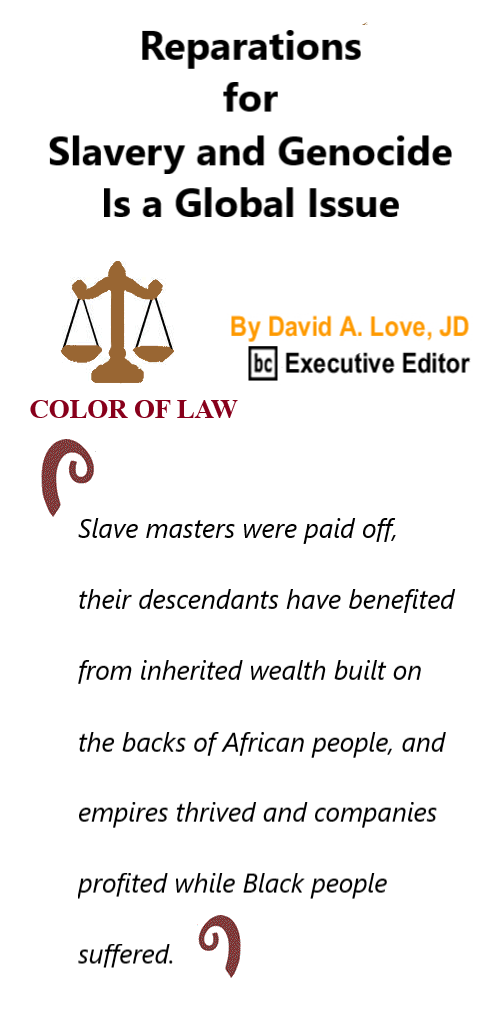
slave masters were paid off, their
descendants have benefited from inherited
wealth built on the backs of African people,
and empires thrived and companies profited
while Black people suffered.
Meanwhile,
Germany
has offered Namibia €1.1
billion
or$1.3 billion in
reparations for the colonial-era genocide
and land seizure of 100,000 Herero and
Nama people who resisted German rule
between 1904 and 1908, when the European
power controlled what was then called
German South-West Africa. Namibian Vice
President Nangolo Mbumba said the amount
Germany has offered in reparations for
genocide is insufficient. “I don't think
that any Namibian would think that the
money is enough to compensate for all that
happened - to be killed, to be chased out
of your country; no amount of money can do
that,” he said.
This news
is a reminder that the issue of
reparations - for the enslavement, torture
and mass murder of Black people - is not
merely an issue of importance to Black
Americans, but a transatlantic and African
diasporic issue. It only makes sense that
those who have faced bondage, slaughter
and unspeakable violations should make
reparations a global concern. In light of
the protests following the police murder
of George Floyd, the UN
Human Rights Council has
called for reparations for people of
African descent, including financial
compensation, and other “guarantees” to
prevent injustices in the future.
We must link the issue of
reparations in the U.S. and everywhere else,
because there is strength in numbers.
Although now is the time for America to make
amends, America is not alone. And while the
U.S. descendants of the enslaved should and
must seek reparations, they are not alone.