Once
regarded
as the nation’s most
important swing
state,
Florida has moved sharply to the
right under Republican control.
Donald Trump has carried the state
three times. Gov. Ron DeSantis has
used it as a testing ground for
attacks on public education,
immigrants, LGBTQ communities,
reproductive freedom and organized
labor. Meanwhile, Florida
Democrats have repeatedly
responded to Republican victories
by moving toward the political
center—or further right—in hopes
of winning back conservative voters.
Oliver
Larkin believes that strategy has failed.
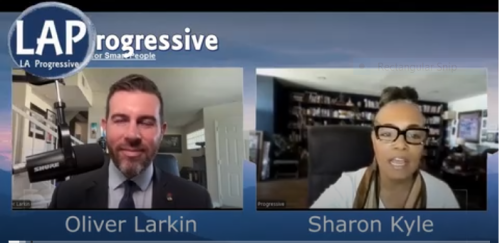
Larkin,
a
union organizer, activist and
member of the Democratic
Socialists of America, is
challenging incumbent Rep.
Jared
Moskowitz in the Democratic
primary for Florida’s newly
configured 25th Congressional
District.
He
is
running on Medicare for
All,
a $25 federal minimum wage,
universal childcare, paid family
and medical leave, stronger labor
protections and an end to private
prisons. He supports
abolishing qualified
immunity and
the
federal death penalty. He also
calls for ending U.S. support for
Israel’s assault on Gaza and
redirecting military spending
toward the needs of working people
at home.
For
Larkin, these positions are not a
political liability. They are the basis of
a Democratic revival.
“We’ve
gone
from being a purple state—a swing
state—to nominating these very
conservative Democrats that adopt
the Republican Party’s positions,”
Larkin told LA Progressive.
“And we’ve seen our state go
further and further to the right.”
His
argument is straightforward: Democrats
will not defeat Republicans by becoming
less distinguishable from them.
Larkin
describes himself as a first-time
candidate but a longtime organizer.
After
college,
he was working as a line cook for
$7.25 an hour while carrying
student-loan debt and watching the
healthcare system fail members of
his family. Inspired by Bernie
Sanders’ 2016 presidential campaign,
he
left his job and traveled to New
Hampshire as a volunteer.
That
campaign gave him a political vocabulary
for frustrations he had already
experienced personally.
He
later
helped unionize his workplace with
the NewsGuild-Communications
Workers of America and
continued organizing in
South
Florida, including with the
Broward County chapter of the
Democratic Socialists of America.
His
campaign platform reflects that
background. Larkin speaks less about
expanding narrowly targeted assistance
than about establishing universal economic
rights.
“The
things
that we need to live the American
dream” include healthcare,
childcare, education, paid leave
and wages sufficient to live on,
he said.
Paying
for those programs, he argues, requires
confronting the enormous sums the United
States spends on war, military contractors
and support for foreign governments.
“We
have
to end our addiction to these
endless wars overseas,” Larkin
said, “so that we can reduce the
cost of living here locally and
return our democracy back to the
power of the working class and
away from the billionaires and
oligarchs.”
Larkin’s
campaign
is not simply an ideological
challenge to the Republican Party.
It is also an indictment of
Democrats who cooperate with the
Trump administration or adopt
conservative positions in the name
of bipartisanship.
His
target is Moskowitz, who has represented
South Florida in Congress since 2023 and
previously served in DeSantis’
administration as Florida’s director of
emergency management.
Larkin
repeatedly describes Moskowitz as a
“DeSantis Democrat.”
Among
his
principal criticisms are
Moskowitz’s participation in the
congressional DOGE Caucus and
his
vote for the Laken
Riley
Act,
legislation that expanded
mandatory immigration detention
and gave state officials greater
power to challenge federal
immigration decisions.
Moskowitz
was among 46 House Democrats who supported
the measure.
To
Larkin, votes such as these reveal the
danger of Democrats accommodating Trump’s
agenda rather than confronting it.
“We’re
seeing
the direct harm that these
Democrats who are working with the
Trump administration are causing,”
he said, pointing to federal
layoffs, attacks on collective
bargaining agreements
and
the expansion of immigration
detention and deportation.
Larkin
also criticizes Moskowitz for trading
stocks while serving on the House Foreign
Affairs Committee, including investments
involving defense contractors. Moskowitz
has faced scrutiny over stock-reporting
violations, although he has said the
trades were made by a financial adviser
without his direct involvement.
The
broader issue, Larkin argues, is a
political system in which lawmakers may
personally profit from companies affected
by the policies they oversee.
“When
there
is this level of private profit
motive in our foreign-policy
apparatus,” he said, “it is going
to keep happening until we have a
majority in Congress that is able
to stand up and draw a line in the
sand.”
Florida’s
congressional map has again been redrawn
by Republicans, and the revised 25th
District is more favorable to the GOP than
the district Moskowitz previously
represented.
Larkin
acknowledges
that Trump carried the territory
encompassed by the new district in
2024. But he rejects the
conclusion that Democrats must
therefore nominate a centrist.
He sees
the new district’s geography as an
organizing opportunity.
The
district
now connects communities across
Palm Beach, Broward and Miami-Dade
counties, bringing together a
multiracial electorate that
includes
significant Caribbean, Central
American, South American and
Jewish populations.
It
also
brings together progressive organizations
and
Democratic Socialists of America
chapters that had previously
operated in separate congressional
districts.
“We
have
a really robust field-organizing
apparatus that we’re using to
contact voters,” Larkin said.
His
campaign is relying on door-to-door
conversations, volunteer canvassing and
direct challenges to the incumbent’s
voting record. Larkin says he personally
knocks on doors, often campaigning in a
tie and short sleeves beneath the South
Florida sun.
He
believes many voters—including
independents—are alarmed by immigration
raids, federal job cuts and the growing
reach of the Trump administration.
The
campaign’s task, as he sees it, is to
convince those voters that the answer is
not a more cautious Democratic Party.
“We
need
to stand up to both
political-party establishments,”
Larkin said, “because the
Republicans have not served us and
the Democrats have failed to stop
them.”
Larkin’s
candidacy raises a question confronting
much of the American left: Can the
Democratic Party be transformed, or must
it eventually be replaced?
His
answer is pragmatic rather than
sentimental.
He
recalls former Rep. Keith Ellison’s
description of political parties as
vehicles—useful only to the extent that
they move people toward a desired
destination.
For
Larkin, that destination includes
universal healthcare, living wages, union
rights, tuition-free public education,
childcare and paid leave.
“The
Democratic
Party can be that vehicle,” he
said, “but not with the current
political leadership within it.”
Larkin is
not presently calling for abandoning the
party. He points to the success of
democratic socialists and working-class
progressives who have defeated
establishment-backed candidates in
Democratic primaries.
But he
does not believe elections or internal
party reform will be sufficient by
themselves.
The New
Deal,
he notes, was driven by organized
labor. Civil-rights legislation
was forced onto the national
agenda by a mass movement. Women’s
rights, LGBTQ rights and other
democratic advances likewise
required pressure generated
outside formal party institutions.
“We
have
always needed outside pressure to
bend this party,” Larkin said.
That is
the role he believes unions, community
organizations, social movements and the
Democratic Socialists of America must
continue to play.
“I’m
not
quite ready to break away from the
Democratic Party when progressives
are seeing such amazing success
running within it,” he said. “But
we need to be clear-eyed.”
Larkin’s
campaign website originally offered
detailed positions on healthcare, housing,
immigration and agriculture but lacked a
similarly developed criminal-justice
platform.
When
asked about that omission, he said the
campaign planned to add one.
His
stated positions are considerably more
expansive than those of most Democratic
congressional candidates.
Larkin
supports
abolishing private prisons, ending
qualified immunity, passing the
George Floyd Justice in Policing Act
and
eliminating the federal death
penalty. He favors removing
cannabis from the federal
controlled-substances schedules
and easing restrictions that
impede research into the
therapeutic use of psilocybin.